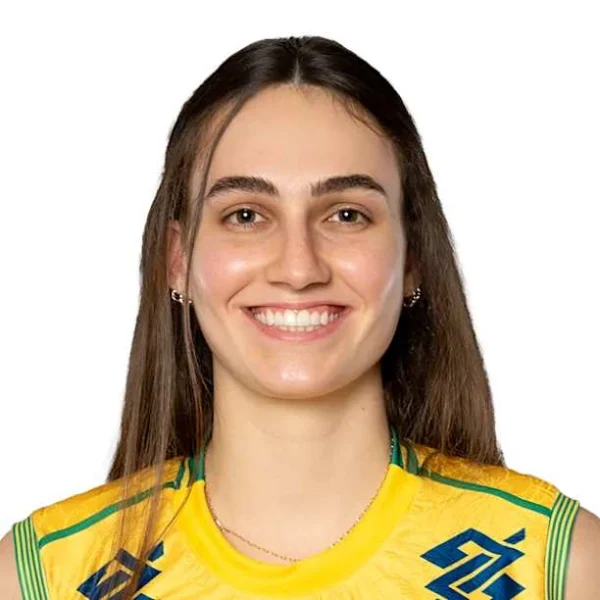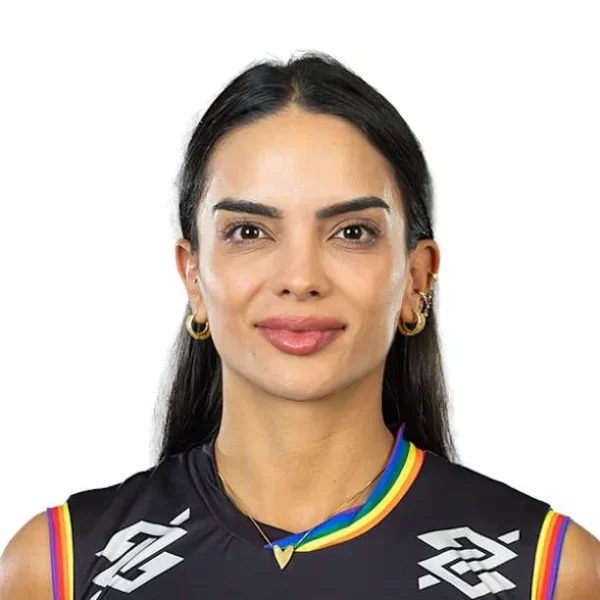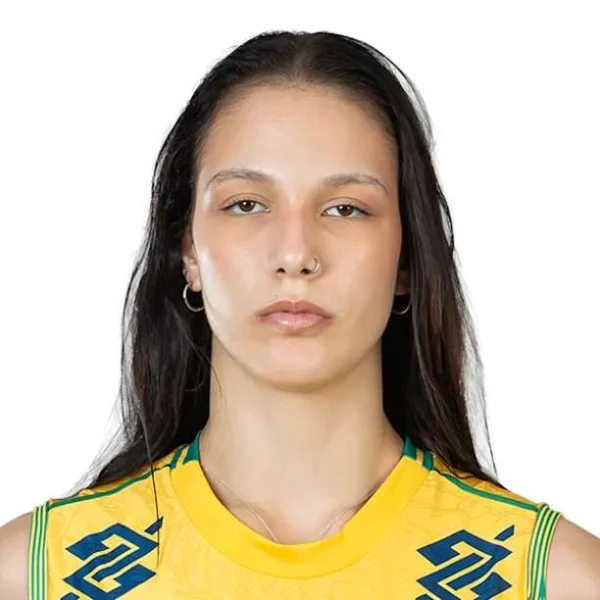
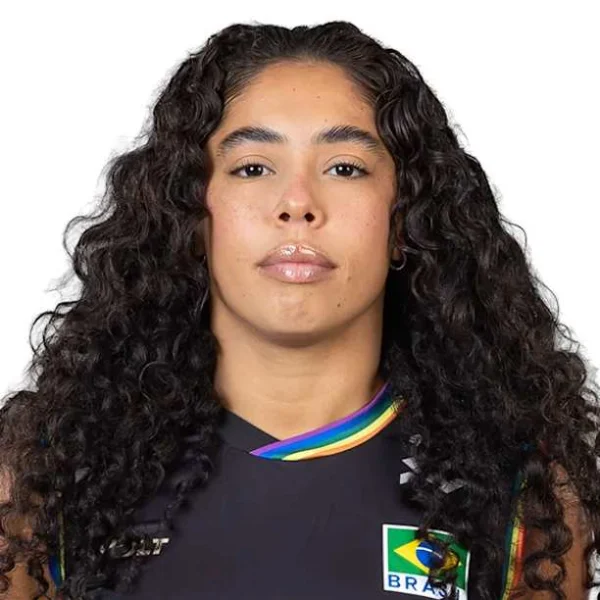
Marcelle de Arruda Mattos da Silva is a Brazilian libero from Rio de Janeiro who plays for Osasco São Cristóvão Saúde and the Brazil women’s national team. Born on February 2, 2002, the 163 cm defender spent much of her youth career as an outside hitter before converting to libero as she entered senior volleyball. Her club development took her from Tijuca Tênis Clube to Sesc RJ Flamengo and Fluminense before a 2026 move to Osasco.
Marcelle’s senior international rise came unusually quickly. Invited to train with Brazil for the first time in 2025, she recovered from an early VNL knee injury, won the starting libero position during the tournament’s third week and finished the year with VNL silver and World Championship bronze. She remained an important part of Brazil’s 2026 team, collecting another VNL silver and a South American title that secured qualification for the Los Angeles 2028 Olympics.
Player Information
| Field | Details |
|---|---|
| Full Name | Marcelle de Arruda Mattos da Silva |
| Common Name | Marcelle Arruda |
| Date of Birth | February 2, 2002 |
| Place of Birth | Rio de Janeiro, Brazil |
| Nationality | Brazilian |
| Position | Libero |
| Youth Position | Outside Hitter |
| Height | 163 cm |
| Listed Weight | 54 kg |
| Listed Spike Reach | 286 cm |
| Listed Block Reach | 262 cm |
| Dominant Hand | Right |
| Previous Clubs | Tijuca Tênis Clube, Sesc RJ Flamengo, Fluminense FC |
| Current Club | Osasco São Cristóvão Saúde |
| Club Number | 22 |
| National Team | Brazil Women’s National Volleyball Team |
| National-Team Number | 22 |
| Career Status | Active |
| @marcelle_13 |
Volleyball World currently lists Marcelle at 163 cm, the same figure used in her 2019 international youth roster. Some later secondary databases list her at 168 cm, but the current governing-body profile supports 163 cm as the stronger height figure.
Her 54 kg weight, 286 cm spike reach and 262 cm block reach come from her youth international profile and should be read as historical listed measurements rather than current testing data. The right-handed designation is also supported by the available player-database record.
Marcelle wears No. 22 for Osasco in the 2026–27 Superliga. Volleyball World’s current 2026 player profile also lists her as No. 22 for Brazil, while she wore No. 30 during the 2025 World Championship.
Early Life & Volleyball Beginnings
Marcelle grew up in the Morro da Formiga community in Tijuca, in Rio de Janeiro’s North Zone. Her first sporting interest was football rather than volleyball. As a child, she wanted to attend a football trial connected to Salgueiro, but the planned test did not take place. Volleyball was being played nearby, and she joined in.
The unexpected change of sport became permanent. Marcelle later entered the Tijuca Tênis Clube development system, where she received the structured training that shaped most of her youth career. A 2018 profile from Voz das Comunidades described how the initial football plan led to volleyball and eventually to an invitation to train at Tijuca.
She did not begin as a libero. Despite being considerably shorter than the typical elite attacker, Marcelle played outside hitter through much of her youth development. At Tijuca she won state-level age-group titles and progressed into Rio de Janeiro youth selections before earning opportunities with Brazil.
That attacking background remained part of her game until the transition toward senior volleyball. Instead of being developed from childhood as a back-row specialist, Marcelle learned the game through front-row and six-rotation responsibilities before her professional path moved decisively toward libero.
Club Career
Tijuca Tênis Clube and the Position Change
Tijuca was Marcelle’s main development home for several years. She competed in the club’s youth program, appeared for the senior side and built enough of a reputation to enter Brazil’s age-group national teams.
Her years there were still centered largely on outside hitter. The position made her height an obvious limitation at higher levels, but it also required her to handle serve reception, defense and transition play—the skills that would later become the foundation of her career as a libero.
The decisive change came around 2020. Marcelle was still training and competing with Tijuca when Sesc RJ Flamengo’s senior coaching staff began looking at her as a defensive option. An injury elsewhere in the Sesc roster created an opening, and Bernardinho’s staff invited her to train with the professional team.
A Sudden Superliga Opportunity with Sesc RJ Flamengo
Marcelle’s move into senior professional volleyball happened quickly. In the 2020 Campeonato Carioca, she faced Sesc RJ Flamengo while still with Tijuca and caught the attention of the club’s staff. Sesc had also lost starting libero Natinha to a knee injury, creating an immediate need in the position.
Marcelle was invited into the squad and initially watched more experienced players handle the libero role. Her first major senior opportunity came in the opening round of the 2020–21 Superliga against Brasília.
A physical problem forced a teammate out, and Bernardinho sent the 18-year-old Marcelle onto the court. She helped Sesc turn the match around for a 3–1 victory and was voted the VivaVôlei player of the match on her Superliga debut. The breakthrough performance effectively confirmed the direction of her career: the former youth outside hitter now had a path as a professional libero.
She remained with the Sesc RJ Flamengo organization for four seasons, from 2020–21 through 2023–24. Those years gave her daily exposure to Bernardinho’s training environment and a roster accustomed to competing near the top of Brazilian volleyball.
Her role was not always that of an unquestioned starter. The period instead served as a long professional apprenticeship, with Marcelle developing her reception and floor defense while learning from established players and adapting fully to the specialist position.
By her final Sesc season, she had accumulated several years of Superliga experience and was ready to seek a club where she could own the libero role rather than mainly provide depth.
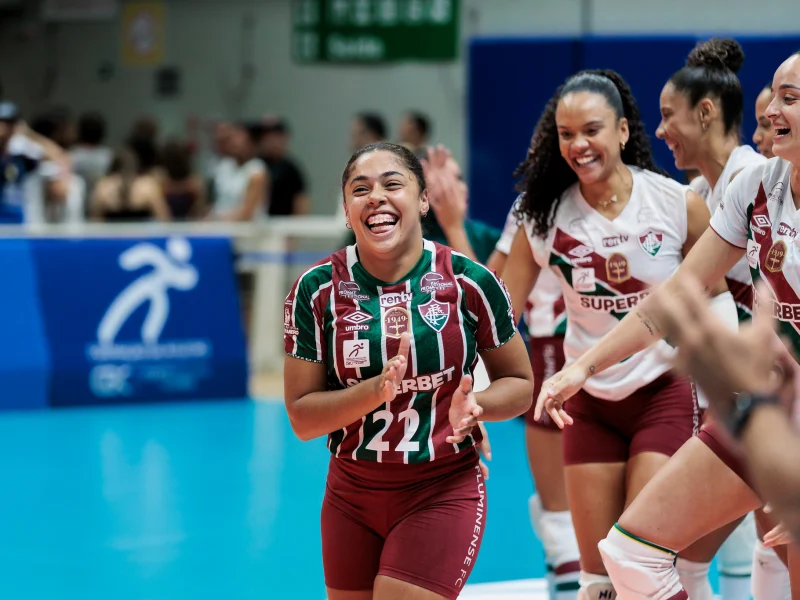
Fluminense and the Chance to Become a Full-Time Starter
Fluminense signed Marcelle for the 2024–25 season. The move was important because the club offered exactly what she had been seeking: a clear opportunity to play regularly in her natural position.
When the transfer was announced, Marcelle said she was happy to have the chance to play consistently as a libero. She also reunited with coach Guilherme Schmitz and several players she already knew from Rio and Brazil’s youth national-team structure.
The first season became a genuine turning point. Marcelle established herself as Fluminense’s starting libero, helped the club win the 2024 Campeonato Carioca and played a central role in its strongest Superliga regular-season campaign to that point. Fluminense finished fourth in the 2024–25 regular-season standings and reached the playoffs.
For Marcelle, the value of that season went beyond the results. It was the first full Superliga campaign in which she carried the week-to-week responsibility of being a starting libero. The volume of receptions and defensive actions gave her the match experience that had been harder to accumulate in previous seasons.
Her performances eventually drew the attention of the senior national-team staff. Fluminense described 2024–25 as a “turning point” in her career when announcing her contract renewal for another season.
Marcelle remained with Fluminense through 2025–26. By then, however, her status had changed dramatically. She returned from the 2025 international season not simply as Fluminense’s starting libero but as a World Championship medalist and a leading candidate for Brazil’s long-term national-team role.
Osasco and the Camila Brait Succession
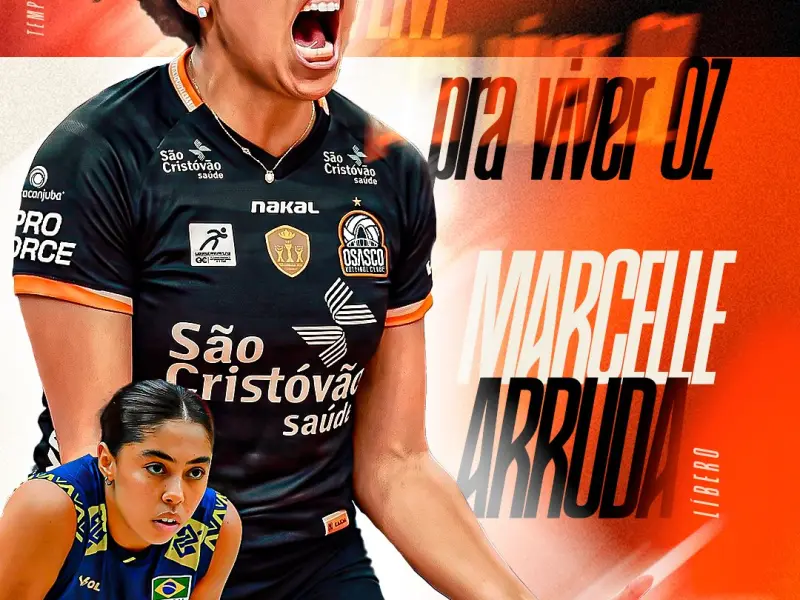
In July 2026, Osasco São Cristóvão Saúde announced Marcelle as its new starting libero. The transfer carried unusual significance because she was chosen to succeed Camila Brait, who had occupied the position at the club for almost two decades.
Marcelle admitted that she initially struggled to believe the offer was real. In discussing the move to Osasco, she described joining such a traditional club—and following Brait—as both a privilege and a major responsibility.
The transition was delayed slightly by Brazil duties. Marcelle spent much of the domestic preseason with the national team and only joined Osasco late in September after winning the South American Championship.
She quickly became the starting libero. Osasco won the 2026 Campeonato Paulista, defeating Sesi Vôlei Bauru through a Golden Set after the two-legged final finished level. Marcelle started the deciding match as the club secured its 19th state championship.
Only three days later, Osasco defeated Dentil/Praia Clube 3–0 to win the 2026 Brazilian Super Cup. Marcelle again started at libero, giving her two club titles within her first weeks in the new team.
Club Career Timeline
| Seasons | Team | Country |
|---|---|---|
| 2013–20 | Tijuca Tênis Clube youth system | Brazil |
| 2018–20 | Tijuca Tênis Clube | Brazil |
| 2020–24 | Sesc RJ Flamengo | Brazil |
| 2024–26 | Fluminense FC | Brazil |
| 2026–present | Osasco São Cristóvão Saúde | Brazil |
The timeline reflects the overlap between Marcelle’s youth and senior activity at Tijuca. Her early club years were primarily spent as an outside hitter, while the move into Sesc RJ Flamengo marked the point at which libero became her professional position.
National Team Career
Youth Brazil and the 2019 World Bronze
Marcelle reached Brazil’s youth national teams while still playing outside hitter for Tijuca. Her first major international medal came at the 2019 FIVB Girls’ U18 World Championship in Egypt.
Brazil reached the semifinals before losing to eventual champion United States. The team then defeated China 3–1 in the bronze-medal match to return to the podium at the age-group World Championship.
Marcelle was part of that squad at 17. The 2019 tournament records confirm Brazil’s bronze, an early international result that came before her full conversion to libero.
Her youth pathway continued after the pandemic interrupted the normal age-group calendar. By 2021 she was playing libero for Brazil’s development teams rather than continuing as an outside hitter.
Junior Pan American Games Gold
Marcelle represented Brazil at the inaugural Junior Pan American Games in Cali-Valle in 2021. Tournament records list her as the Brazilian libero, wearing No. 19.
Brazil went undefeated through the competition and reached the final against Peru. The championship match went five sets after Peru recovered from a two-set deficit, but Brazil won the tie-break 15–8 to take gold.
The Junior Pan American title was Marcelle’s first major international gold medal. It also showed that the positional transition had been completed at national-team level: she was no longer an undersized outside hitter being considered for a different role, but a specialist libero.
From Training Invite to Brazil Starter in 2025
Marcelle’s first senior national-team opportunity did not begin with a formal place in Brazil’s core group. After her breakout Fluminense season, José Roberto Guimarães invited her to train with the team in May 2025 ahead of the Volleyball Nations League.
It was the first time she had trained with Brazil’s senior squad. Marcelle was then included in the wider VNL roster, but her first international summer immediately brought another obstacle.
A knee injury during the opening stage kept her out of the first week in Rio de Janeiro and prevented her from traveling to the second week in Türkiye. Her competitive debut therefore had to wait until the third week in Chiba, Japan.
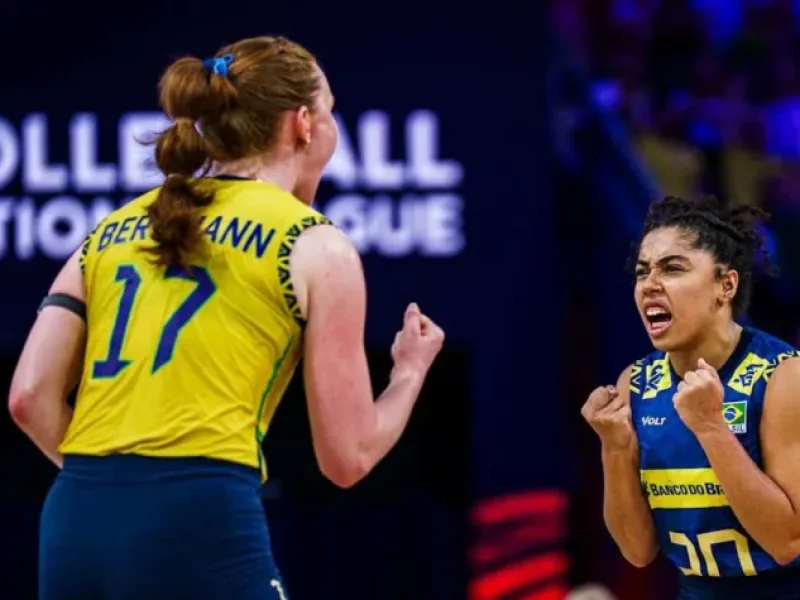
Marcelle entered during Brazil’s match against France and immediately gave the team stability in reception and defense. From that point, she took over the starting role and kept it through the VNL Finals.
Her six-match stretch was statistically strong. Contemporary reporting credited her with 64 digs in six matches, while her positive reception rate finished around 62%. She reached the final phase as one of the competition’s leading receivers despite having entered the tournament only in its final preliminary week.
Brazil reached the gold-medal match against Italy. Marcelle started the final and recorded 11 digs and seven receptions, but Italy recovered from losing the first set and won 3–1. Brazil took silver, giving Marcelle a major medal in her first senior international competition. Volleyball World highlighted her among the younger players who had taken on important roles during the tournament.
Starting Libero at the 2025 World Championship
The VNL established Marcelle as a candidate for Brazil’s World Championship roster, but the speed of the rise remained unusual. Only a few months earlier she had entered the national-team environment as a training invite.
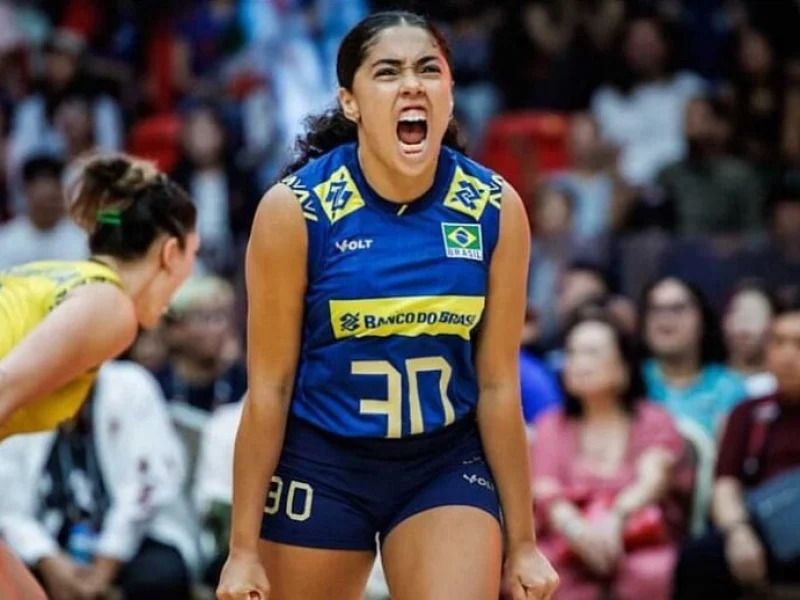
By the World Championship in Thailand, she was Brazil’s starting libero.
Marcelle started throughout the knockout stages as Brazil reached the semifinals. The team pushed Olympic champion Italy to five sets, losing 15–13 in the tie-break after leading the match twice.
Brazil then faced Japan in the bronze-medal match. Marcelle started again as the South Americans won a dramatic five-set contest, 18–16 in the deciding set. The victory over Japan gave Brazil World Championship bronze and Marcelle her second major senior international medal in a matter of weeks.
Her performances also led to frequent comparisons with former Brazil libero Fabi Alvim. Fans jokingly called her “Marcelle Alvim,” although Fabi herself stressed that Marcelle should be allowed to build her own identity rather than carry expectations created by comparisons with a two-time Olympic champion.
The broader point was difficult to miss: Marcelle had gone from a first-time training invite to Brazil’s starting libero at a World Championship in a single international season.
VNL 2026 and a Second Silver Medal
José Roberto Guimarães removed any doubt about Marcelle’s place in the following cycle by including her in the first Brazil call-up of 2026. She entered the season as an established senior-team libero rather than an invited prospect.
Brazil again advanced deep into the VNL, and Marcelle remained an important part of the defensive unit. Her strongest documented performance came in the semifinal against Italy.
With family and friends watching from the Morro da Formiga in Rio, Marcelle produced 15 digs and six assists, along with 75% positive reception and 33% perfect reception, as Brazil defeated Italy to reach the final. The semifinal performance was one of the clearest examples of her ability to handle high-pressure serving and attacking against elite opposition.
Türkiye beat Brazil 3–1 in the final, leaving Brazil with another silver medal. Marcelle had now reached the VNL final in each of her first two senior international seasons.
South American Champion and LA28 Qualification
Brazil’s most important result of 2026 came at home in September. The South American Championship at the Maracanãzinho offered more than a continental title: the winner would earn a direct place at the Los Angeles 2028 Olympic Games.
Marcelle remained in the Brazilian group for the tournament. Brazil won all five matches without losing a set and defeated Argentina 3–0 in the decisive match.
The South American title secured Brazil’s direct Olympic qualification and extended the country’s run to 16 consecutive continental championships. For Marcelle, it added a first senior continental gold medal to the VNL silvers and World Championship bronze she had already collected since entering the national team in 2025.
Playing Style & Strengths
Marcelle’s strongest evidence comes in serve reception and floor defense. Her rise with Brazil was built on stabilizing first contact rather than producing points, and the statistical record from her first two international seasons repeatedly shows those two areas.
During the 2025 VNL, she finished her six-match run with approximately 62% positive reception and 64 digs. The context matters: Marcelle entered the tournament late, after a knee injury, and took over the starting job almost immediately rather than building gradually into the lineup.
Her 2026 semifinal against Italy provides another useful example. Facing one of the strongest attacking and serving teams in the world, she finished with 15 digs and 75% positive reception. That performance helped Brazil turn a difficult semifinal into a place in the VNL final.
Marcelle is particularly effective when rallies extend beyond the first defensive contact. She covers a large amount of backcourt space and is willing to defend aggressively outside the ideal platform position rather than allowing difficult balls to drop. Her role in Brazil’s system also requires her to coordinate coverage behind Gabi, Julia Bergmann, Ana Cristina and the team’s middle blockers as those attackers move between front and back row.
Her development as an outside hitter is relevant to that defensive profile. Marcelle spent years receiving serve and playing six rotations before becoming a libero, so the first-contact side of the game was already familiar when she stopped carrying an attacking responsibility. The conversion allowed her to concentrate those skills into a position better suited to her 163 cm frame.
Ball control after the dig is another part of her value. In international matches she is frequently responsible for keeping second contacts playable when the setter makes the first defensive touch. Her six assists against Italy in the 2026 VNL semifinal illustrate that responsibility.
The clearest sign that her international form has transferred into club volleyball came at the start of the 2026–27 Superliga. The CBV’s current Osasco statistics list Marcelle at 76.56% reception efficiency, placing her among the competition’s strongest early-season passers. Because league and international platforms calculate reception differently, that figure should not be compared directly with VNL percentages, but the underlying pattern is consistent: first contact remains the central strength of her game.
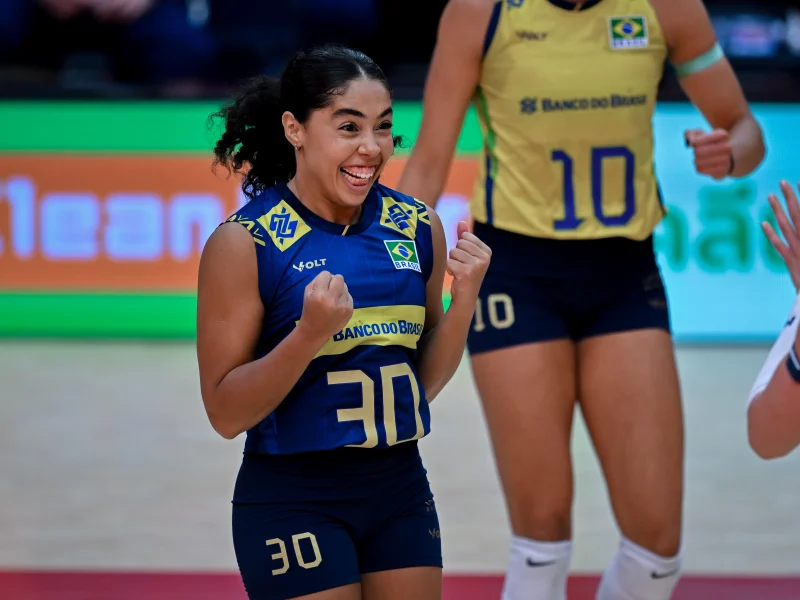
Major Achievements
Selected National Team Honors
| Year | Competition | Result |
|---|---|---|
| 2019 | FIVB Girls’ U18 World Championship | Bronze |
| 2021 | Junior Pan American Games | Gold |
| 2025 | Volleyball Nations League | Silver |
| 2025 | FIVB Women’s World Championship | Bronze |
| 2026 | Volleyball Nations League | Silver |
| 2026 | South American Championship | Gold |
The sequence from 2025 onward is particularly notable because Marcelle collected her first three major senior global medals within her first two seasons in Brazil’s senior team.
Selected Club Honors
| Year / Season | Competition | Result | Team |
|---|---|---|---|
| 2020 | Super Vôlei | Silver | Sesc RJ Flamengo |
| 2024 | Campeonato Carioca | Champion | Fluminense FC |
| 2026 | Campeonato Paulista | Champion | Osasco São Cristóvão Saúde |
| 2026 | Brazilian Super Cup | Champion | Osasco São Cristóvão Saúde |
The two Osasco titles arrived within days of one another. Marcelle started at libero when Osasco defeated Sesi Bauru through a Golden Set to win the Paulista and again when the club swept Praia Clube in the Super Cup final.
Family & Community
Morro da Formiga remains closely connected to Marcelle’s career. She spent most of her life in the Tijuca community, and her progress from local youth volleyball to the national team has continued to be followed there.
That connection was particularly visible during the 2026 VNL Finals. Around 40 family members and friends gathered in the community early in the morning to watch Brazil’s semifinal against Italy on a large screen. Marcelle acknowledged them immediately after the victory.
Her mother, Lucélia, has also appeared publicly alongside her during the rapid national-team rise. When Marcelle began receiving comparisons with Fabi Alvim after the 2025 World Championship, Lucélia joined Marcelle and Fabi for a television reunion that reflected how quickly her daughter’s career had changed.
The community background is more than a convenient origin story. Marcelle moved from playing football and volleyball around Tijuca to a professional pathway without leaving Rio for her first decade in the sport. Tijuca, Sesc RJ Flamengo and Fluminense all kept her career rooted in the same city until the 2026 transfer to Osasco.
Where Is Marcelle Arruda Playing Now?
As of November 5, 2026, Marcelle Arruda plays for Osasco São Cristóvão Saúde in Brazil’s Superliga and wears No. 22.
She joined the club for 2026–27 after two seasons with Fluminense. Osasco selected her to replace retired club icon Camila Brait, making the transfer one of the more visible positional changes of the Brazilian offseason.
Marcelle has already started in two title-winning Osasco lineups. The club won the Campeonato Paulista in October and followed three days later with a 3–0 victory over Praia Clube in the Brazilian Super Cup.
Her early Superliga form has also been strong in first contact. The CBV’s current Osasco player statistics list her at 76.56% reception efficiency in the opening phase of the 2026–27 season.
Internationally, Marcelle remains active with the Brazil Women’s National Volleyball Team. Her 2026 season included VNL silver and the South American Championship title that secured Brazil’s place at Los Angeles 2028.
Recent Performance Snapshot
2026 VNL Semifinal vs. Italy
| Metric | Total |
|---|---|
| Digs | 15 |
| Assists | 6 |
| Positive Reception | 75% |
| Perfect Reception | 33% |
| Result | Brazil won and advanced to the final |
The Italy match was one of Marcelle’s strongest documented senior international performances. Brazil defeated the reigning Olympic champions to reach the VNL final, with Marcelle handling a significant share of the defensive workload.
Early 2026–27 Brazilian Superliga
| Metric | Current Figure |
|---|---|
| Club | Osasco São Cristóvão Saúde |
| Jersey Number | 22 |
| Position | Libero |
| Reception Efficiency | 76.56% |
The reception figure is date-sensitive and reflects the opening stage of the 2026–27 Superliga as of November 5, 2026. It should not be treated as a full-season statistic.
Frequently Asked Questions
How old is Marcelle Arruda?
Marcelle Arruda was born on February 2, 2002, in Rio de Janeiro. She is 24 during the 2026–27 season.
How tall is Marcelle Arruda?
Volleyball World currently lists Marcelle at 163 cm (5 ft 4 in). Some secondary profiles use 168 cm, but 163 cm is the current governing-body figure.
What position does Marcelle Arruda play?
Marcelle plays as a libero. She spent much of her youth career as an outside hitter before changing positions around the start of her senior professional career.
Which club does Marcelle Arruda play for?
Marcelle plays for Osasco São Cristóvão Saúde in Brazil’s Superliga. She joined the club for the 2026–27 season after two years with Fluminense.
What number does Marcelle Arruda wear?
Marcelle wears No. 22 for Osasco. The latest Volleyball World profile also lists her as No. 22 for Brazil, although she wore No. 30 during the 2025 World Championship.
When did Marcelle Arruda debut for Brazil’s senior team?
Marcelle first entered Brazil’s senior training environment in 2025. After missing the opening VNL weeks with a knee injury, she debuted during the third week in Japan, won the starting libero position and finished the competition with a silver medal.
References
- Volleyball World — Marcelle de Arruda Mattos da Silva VNL 2026 player profile
- Volleyball World — Marcelle de Arruda Mattos da Silva 2025 World Championship player profile
- CBV — Osasco São Cristóvão Saúde 2026–27 Superliga roster and player statistics
- Brazilian Volleyball Confederation — 2026 senior women’s national-team call-up
- Fluminense — Marcelle signs for the 2024–25 season
- Fluminense — Marcelle is invited to train with Brazil’s senior national team
- Fluminense — Marcelle renews her contract after her breakthrough season
- Fluminense — Marcelle reflects on Brazil’s 2025 VNL silver medal
- Web Vôlei — Marcelle’s 2020 Superliga breakthrough with Sesc RJ Flamengo
- Voz das Comunidades — Marcelle’s early volleyball years in Morro da Formiga and Tijuca
- Volleyball World — Brazil’s bronze medal at the 2019 Girls’ U18 World Championship
- NORCECA — Brazil win women’s volleyball gold at the 2021 Junior Pan American Games
- Volleyball World — Brazil take silver in the 2025 VNL
- Volleyball World — Brazil beat Japan for bronze at the 2025 World Championship
- ge — Marcelle’s rapid rise from Brazil training invite to World Championship starter
- Web Vôlei — Marcelle’s rise to Brazil’s starting libero role
- ge — Marcelle’s 2026 VNL semifinal performance and Morro da Formiga support
- Volleyball World — Türkiye defeat Brazil in the 2026 VNL final
- FIVB — Brazil win the 2026 South American Championship and qualify for LA28
- Web Vôlei — Marcelle joins Osasco to succeed Camila Brait
- Osasco Voleibol Clube — Osasco win the 2026 Campeonato Paulista
- CBV — Osasco defeat Praia Clube to win the 2026 Brazilian Super Cup
- No Ataque — Marcelle’s verified Instagram and departure from Fluminense
- Women Volleybox — Marcelle Arruda player data and career history