
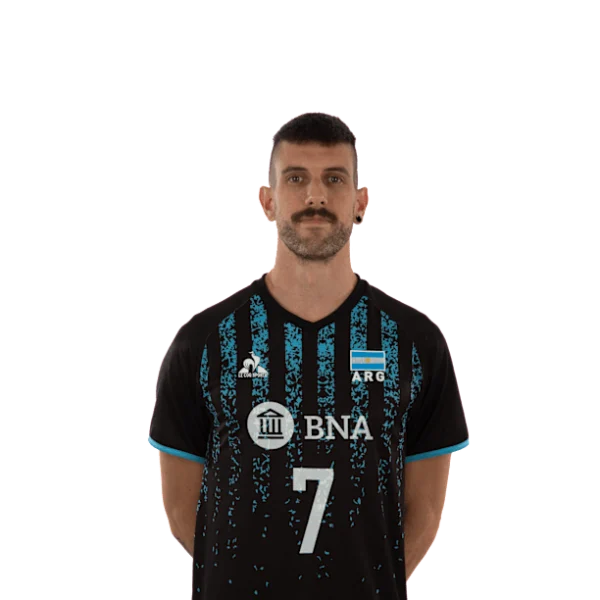
Facundo Conte (born 25 August 1989) is an Argentine former professional volleyball player who played primarily as an outside hitter. Standing 197 cm tall, he represented the Argentina men’s national volleyball team at four Olympic Games between 2012 and 2024 and won a bronze medal at Tokyo 2020. He is the son of Hugo Conte, a member of Argentina’s bronze-medal-winning team at the 1988 Seoul Olympics.
Conte began his professional career in Argentina before moving to Europe as a teenager. He subsequently played for clubs in Italy, Russia, Poland, China, Qatar and Brazil, winning the Polish PlusLiga with PGE Skra Bełchatów and several major domestic titles during his time in Brazil. He returned to Argentina in 2022 to join Ciudad Vóley, where he won consecutive national league championships in 2023 and 2024.
With Argentina, Conte also won gold at the 2015 Pan American Games and the 2023 South American Championship. His Olympic bronze in Tokyo carried particular significance because it made him and his father medalists from two different generations of Argentine men’s volleyball. Conte retired from professional volleyball following the Paris 2024 Olympics, concluding a career that had lasted nearly two decades.
Player Information
| Field | Details |
|---|---|
| Full Name | Facundo Conte |
| Known As | Facu |
| Date of Birth | 25 August 1989 |
| Place of Birth | Vicente López, Buenos Aires Province, Argentina |
| Nationality | Argentine |
| Gender | Male |
| Position | Outside Hitter |
| Secondary Position | Opposite Hitter |
| Height | 197 cm (6 ft 5.6 in) |
| Weight | 88 kg (Olympic biographical listing) |
| Spike Reach | 355 cm (historical Polish league listing) |
| National Team | Argentina Men’s National Volleyball Team |
| National Team Years | 2008/2009–2024 |
| National-Team Number | 7 |
| Last Club | Ciudad Vóley (Argentina) |
| Last Club Period | 2022–2024 |
| Previous Clubs | Rosario Sonder, GEBA, Pallavolo Catania, Zinella Volley Bologna, Cucine Lube, Umbria Volley, Gabeca Pallavolo, Dynamo Krasnodar, PGE Skra Bełchatów, Shanghai Golden Age, El Jaish, Funvic Taubaté, Sada Cruzeiro, Aluron CMC Warta Zawiercie |
| Olympic Appearances | London 2012, Rio 2016, Tokyo 2020, Paris 2024 |
| Olympic Medals | Bronze — Tokyo 2020 |
| Father | Hugo Conte, former Argentine international and Olympic bronze medalist |
| Career Status | Retired (2024) |
| @facuconte7 | |
| X | @facuconte7 |
Early Life & Volleyball Beginnings
Facundo Conte was born on 25 August 1989 in Vicente López, in the Buenos Aires metropolitan area. Volleyball was a familiar part of his childhood because both of his parents had played professionally. His father, Hugo Conte, had established himself as one of Argentina’s most important international players, helping the national team claim bronze at the 1988 Seoul Olympics, while his mother, Sonia, also had a background in professional volleyball.
Growing up in that environment gave Conte early exposure to the sport, although it also meant that comparisons with his father accompanied his development. In interviews, he has described the influence of both parents on his understanding of volleyball and the importance of eventually establishing an identity separate from Hugo’s achievements.
Conte entered Argentina’s professional volleyball system while still in his teens. His early senior experience included the 2005–06 season with Rosario Sonder, followed by a move to Gimnasia y Esgrima de Buenos Aires (GEBA), where he had the unusual opportunity to share the court with his father. Their time together offered a direct connection between two generations of Argentine volleyball before Facundo began pursuing an independent professional career overseas.
The transition to European volleyball came in 2007 when Conte moved to Italy to join Pallavolo Catania. Rather than entering one of Europe’s leading clubs immediately, he developed through the Italian league system, where demanding schedules and established professional competition provided a foundation for his later career. The move also marked the beginning of a long period in which he would alternate between club commitments abroad and international duty with Argentina.
Club Career
Early Professional Years in Argentina and Italy
Conte’s first seasons in Argentina introduced him to senior competition at an age when many players were still developing through youth teams. After starting with Rosario Sonder and moving to GEBA, he joined Pallavolo Catania for the 2007–08 season and remained there for a second campaign. His father was also involved in coaching during this early Italian period, extending their professional connection beyond their shared playing experience in Argentina.
For the 2009–10 season, Conte played with Zinella Volley Bologna in Italy’s second division. His progression through Serie A2 preceded a move into top-division volleyball, including time with Lube during the 2010–11 season. He was part of the Italian club’s squad during its successful 2010–11 CEV Challenge Cup campaign, adding a European club trophy to his early résumé.
Subsequent periods with Umbria Volley and Gabeca Pallavolo gave him additional experience in the Italian professional system. By this stage, he was also becoming a regular presence in Argentina’s international plans, meaning that his club seasons increasingly had to be balanced against major national-team tournaments.
Russia and the Move to PGE Skra Bełchatów
Conte joined Dynamo Krasnodar for the 2012–13 season, adding Russia to his growing list of European destinations. The Russian Super League offered a different competitive environment, particularly in terms of physical play and the demands placed on attacking outside hitters.
His next major move came in 2013, when he signed with PGE Skra Bełchatów in Poland. The club was one of the established powers of the Polish PlusLiga, and Conte joined a squad that included prominent international players such as Mariusz Wlazły and fellow Argentine Nicolás Uriarte.
The 2013–14 season became one of the defining club campaigns of Conte’s career. Skra won the Polish championship after returning to the league’s leading position, and Conte contributed as an important part of the team’s outside-hitting rotation. His arrival coincided with a successful period for the club, which subsequently competed in the CEV Champions League.
In October 2014, Skra defeated ZAKSA Kędzierzyn-Koźle 3–1 to win the Polish SuperCup. Conte was named the match’s Most Valuable Player, a notable individual achievement in a team featuring several established Polish internationals.
During the 2014–15 season, Skra advanced to the CEV Champions League Final Four in Berlin. Their European campaign included victories over Cucine Lube and Sir Safety Perugia in the knockout rounds, demonstrating the team’s competitiveness against leading Italian opposition.
Conte remained in Bełchatów through the 2015–16 season. His three-year period in Poland was important not only because of the domestic championship but also because he became an established attacking player in one of Europe’s strongest national leagues.
China, Qatar and Brazil
After leaving Poland in 2016, Conte moved to Shanghai Golden Age in the Chinese Volleyball League. His time in China formed part of a successful period for the club, with championship-winning campaigns adding to his experience outside Europe.
He also played for El Jaish in Qatar in 2017, continuing a career that increasingly crossed several of the world’s major professional volleyball markets.
Conte then moved to Brazil, where he represented Funvic Taubaté during the 2018–19 season. That campaign ended with Taubaté winning the Brazilian Superliga, giving Conte another domestic championship in a different country.
He joined Sada Cruzeiro for the following two seasons, placing him within one of South America’s most successful club programs. With the Minas Gerais side, Conte competed in Brazilian domestic competitions, the South American Club Championship and the FIVB Club World Championship.
His spell at Sada Cruzeiro included the 2020 South American Club Championship title and the 2020 Brazilian Cup, while the club also reached the final of the 2019 FIVB Club World Championship. Conte was recognized among the tournament’s leading outside hitters in 2019, reflecting his attacking contribution against high-level international opposition.
The Brazilian years further expanded his tactical experience. Compared with the structured European league environments in which he had played earlier, Brazil demanded continuous adaptation to different serving patterns, defensive systems and attacking combinations. Conte’s versatility allowed him to remain an influential outside hitter across these changes.
Return to Poland with Aluron CMC Warta Zawiercie
For the 2021–22 season, Conte returned to the Polish PlusLiga, this time joining Aluron CMC Warta Zawiercie. His previous success with Skra Bełchatów had already made him a familiar player to Polish volleyball followers.
Warta Zawiercie finished third in the 2021–22 PlusLiga, and Conte played a significant role in the team’s campaign. League records list him with 496 points across 34 appearances that season, illustrating his continued importance as an attacking option.
The return to Poland proved to be his final European club chapter. Despite the opportunity to continue competing abroad, Conte decided that returning to Argentina had become an important personal and professional objective.
Final Club Chapter with Ciudad Vóley
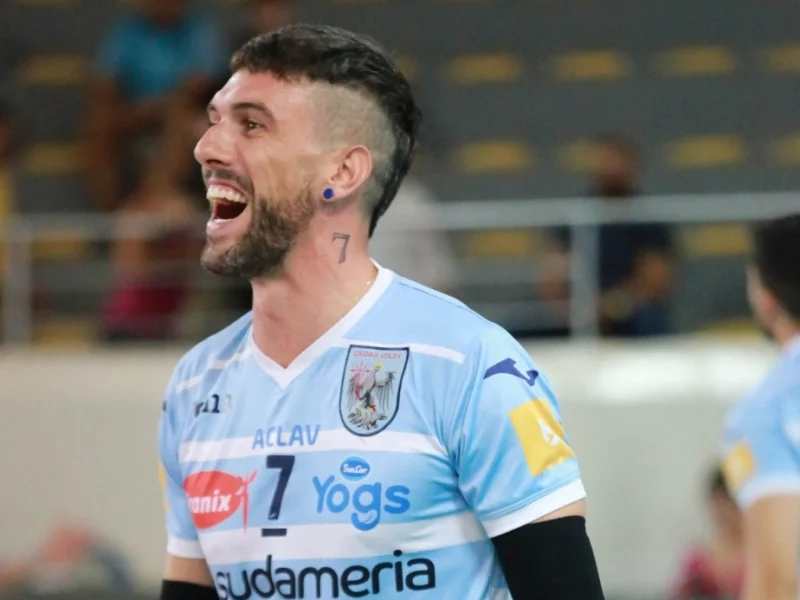
In May 2022, Conte announced his return to Argentine volleyball by joining Ciudad Vóley. The move had special significance because Ciudad was connected to his early development in the sport, and it allowed him to spend the closing phase of his professional career closer to home.
His impact was immediate. Ciudad won the 2022–23 Argentine Volleyball League championship, establishing itself as the country’s leading club during that campaign. Conte’s presence brought international experience to a team competing against several established Argentine rivals.
The club defended its national title in 2023–24, completing another successful season with Conte as a central figure. In the decisive match against Policial de Formosa on 19 April 2024, Ciudad recovered from losing the opening set to win 3–1. Conte finished as the team’s leading scorer with 25 points and received the match’s Most Valuable Player award.
Ciudad also reached the final of the 2024 South American Club Championship in Blumenau, Brazil. Although Sada Cruzeiro won the title in straight sets, Ciudad’s runner-up finish secured its first medal in the continental competition and qualification for the FIVB Club World Championship. Conte and setter Gaspar Bitar were selected for the tournament’s ideal team.
That combination of two Argentine league championships and a continental final provided a fitting conclusion to Conte’s club career. His final years were not simply a symbolic return home; he remained a productive player capable of influencing championship matches.
Club Career Timeline
| Seasons | Team | Country |
|---|---|---|
| 2005–2006 | Rosario Sonder | Argentina |
| 2006–2007 | Gimnasia y Esgrima de Buenos Aires (GEBA) | Argentina |
| 2007–2009 | Pallavolo Catania | Italy |
| 2009–2010 | Zinella Volley Bologna | Italy |
| 2010–2011 | Cucine Lube / Volley Lube | Italy |
| 2011 | Umbria Volley | Italy |
| 2011–2012 | Gabeca Pallavolo | Italy |
| 2012–2013 | Dynamo Krasnodar | Russia |
| 2013–2016 | PGE Skra Bełchatów | Poland |
| 2016–2018 | Shanghai Golden Age | China |
| 2017 | El Jaish | Qatar |
| 2018–2019 | Funvic Taubaté | Brazil |
| 2019–2021 | Sada Cruzeiro | Brazil |
| 2021–2022 | Aluron CMC Warta Zawiercie | Poland |
| 2022–2024 | Ciudad Vóley | Argentina |
Some club periods overlap because Conte also participated in shorter regional competitions during a broader seasonal affiliation.
National Team Career
Senior International Development and World Championships
Conte entered Argentina’s senior national-team program around 2008–09, following his progression through the country’s youth system. His early international experience included the period leading into the 2010 FIVB Men’s World Championship in Italy, where Argentina finished ninth.
Despite his relatively young age, Conte was already assuming significant responsibilities in the national-team attack. He developed alongside players who would remain important figures for Argentina during the following decade, including setter Luciano De Cecco.
Argentina’s national program was working toward greater consistency at major international competitions, and Conte became one of the principal outside hitters tasked with providing attacking production from the left side of the court.
The demands of international volleyball differed from his regular club commitments. Argentina frequently faced opponents with greater depth or more established professional leagues, making the team’s ability to organize its serve-reception, transition attack and collective defense particularly important.
Conte continued representing Argentina through multiple World Championship cycles, including the 2014 and 2018 editions. These tournaments contributed to his development as one of the experienced leaders of the national team.
London 2012 and Rio 2016 Olympics
Conte made his Olympic debut at London 2012. Argentina advanced from the preliminary round before losing to Brazil in the quarterfinals, finishing joint fifth in the men’s tournament.
The competition represented an important step for Conte, who was still in the early stages of an international career that would eventually include four Olympic appearances.
Argentina returned to the quarterfinals at Rio 2016. The team produced a competitive group-stage campaign but again encountered Brazil in the knockout phase, losing 3–1 and finishing joint fifth.
For Conte, the first two Olympic tournaments reinforced both Argentina’s ability to compete with leading nations and the difficulty of converting a quarterfinal appearance into a medal.
By the end of Rio 2016, he had become a central figure in the national-team lineup. His experience in major European leagues and his increasingly important role as an attacker positioned him among the established players responsible for leading Argentina into the next Olympic cycle.
Gold at the 2015 Pan American Games
Between his first two Olympics, Conte helped Argentina win the men’s volleyball gold medal at the 2015 Pan American Games in Toronto.
Argentina defeated Brazil 3–2 in the final, securing a major regional title against one of its most familiar international rivals. Conte was one of the important attacking players in that successful campaign and received individual recognition for his tournament performances.
The victory was an important achievement for Argentina’s generation of players. It demonstrated that the national team could produce results against major opponents in decisive matches rather than merely remain competitive during preliminary rounds.
For Conte, the Pan American title was also an early indication of what the same generation might accomplish at a future Olympic Games.
Tokyo 2020: Argentina’s Historic Bronze Medal
The Tokyo 2020 Olympic Games, held in 2021, became the defining international achievement of Conte’s career.
Argentina entered the tournament with an experienced core that included Conte, Luciano De Cecco, Sebastián Solé, Martín Ramos and several other players who had spent years competing at the highest international level.
The team faced a difficult preliminary group containing Brazil, France, the Russian Olympic Committee, the United States and Tunisia. Argentina progressed to the quarterfinals, where it defeated Italy in five sets to reach the Olympic semifinals.
A defeat against France ended Argentina’s gold-medal hopes, but the team still had an opportunity to claim the country’s first Olympic men’s volleyball medal since Seoul 1988.
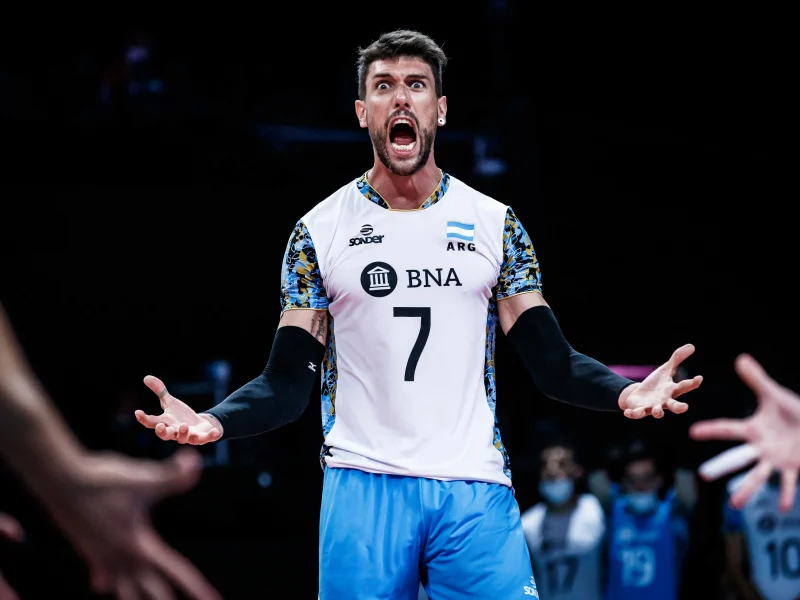
In the bronze-medal match, Argentina defeated Brazil 3–2. The result ended a 33-year gap between Olympic podium finishes and completed one of the most significant campaigns in the history of Argentine volleyball.
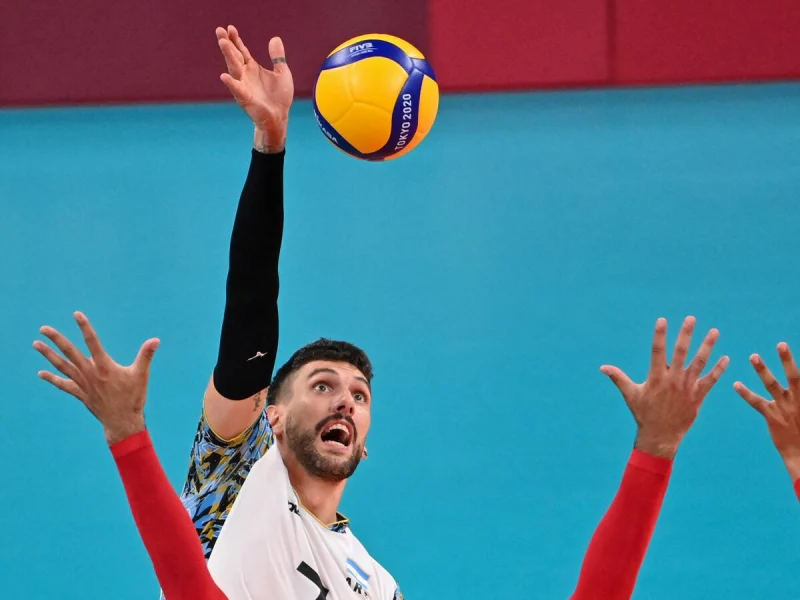
Conte scored 125 points across the Olympic tournament, according to Volleyball World’s retrospective coverage. His attacking role was particularly important because Argentina relied on experienced players to maintain offensive production throughout demanding matches against some of the strongest teams in the world.
The bronze medal also created an unusual family achievement. Hugo Conte had been part of Argentina’s first Olympic bronze-medal team in 1988, while Facundo helped secure the nation’s second in 2021.
Although father and son belonged to very different eras of international volleyball, both contributed to the same country’s only two Olympic men’s volleyball podium finishes through the conclusion of the Paris 2024 Games.
For Facundo, Tokyo was a culmination of more than a decade with Argentina’s senior national team. The medal transformed a career already filled with major tournaments into one permanently associated with a historic national sporting achievement.
2023 South American Championship
Conte added another significant international title when Argentina won the 2023 South American Men’s Volleyball Championship in Recife, Brazil.
The competition culminated in a straight-set victory over the host nation, with Argentina defeating Brazil 25–19, 27–25 and 25–22. Conte finished as Argentina’s leading scorer in the match with 15 points.
The result was historically important because Argentina had not won the South American Championship since 1964. Brazil had dominated the tournament for decades, and the 2023 victory ended a lengthy period in which the continental title had remained beyond Argentina’s reach.
Conte returned to the national team for the continental competition after missing the 2023 Volleyball Nations League. His performance against Brazil demonstrated that he remained an effective attacking option even as younger outside hitters were entering the squad.
The championship became one of the final major international successes of his career, supplementing the Olympic bronze and Pan American Games gold already on his record.
Paris 2024 and International Retirement
Conte made his fourth and final Olympic appearance at Paris 2024, joining a relatively small group of Argentine volleyball players to compete at four editions of the Games.
Argentina struggled in the preliminary round, losing to the United States, Japan and Germany. The final defeat against Germany on 2 August 2024 eliminated the team from the tournament.
Following that match, Conte announced that he was bringing his playing career to an end. He explained that representing Argentina had been central to his life and that he wanted his final appearance to come while wearing the national-team jersey at the Olympic Games.
The retirement announcement marked the end of a senior international career spanning approximately 16 years and four Olympic cycles.
Although Argentina’s final tournament did not produce the result he had hoped for, Conte departed with an Olympic medal, major continental titles and a place in the history of his country’s national team.
Playing Style & Strengths
Conte played primarily as a receiving outside hitter, a position that requires an athlete to contribute to both the team’s attacking structure and its first-contact organization. Unlike a specialist opposite hitter, an outside hitter must repeatedly transition between serve reception, defensive positioning and attacking assignments, often under substantial pressure from the opposing team’s servers.
His strongest offensive quality was his ability to generate effective attacks from different situations. At 197 cm, with a historically listed spike reach of 355 cm, Conte had the physical tools to attack above organized blocks, but his effectiveness was not based on jumping ability alone. He also relied on timing, approach rhythm and shot selection to create scoring opportunities when the set was not ideal.
Outside-Hitting and Transition Attack
Conte was comfortable attacking from the left side in both organized side-out plays and transition situations. His experience across multiple professional leagues exposed him to different offensive systems, which helped him adapt to variations in tempo, setting location and the responsibilities assigned to outside hitters.
When Argentina faced difficult serve-reception situations, Conte could still be used as a high-ball attacking option. Such plays place significant responsibility on a hitter because the opposing defense has more time to organize its block.
His ability to remain productive in these circumstances was especially useful during long international matches, where maintaining attacking efficiency under pressure often determines whether a team can recover from poor first contacts.
Serving and Reception Responsibilities
As a receiving outside hitter, Conte was involved in the first phase of many rallies as well as the final attacking phase. His role required communication with the libero and other passers, particularly when opponents attempted to target him with serves.
His playing style therefore included a balance between offensive responsibility and the need to maintain stability in serve reception. Strong attackers who also handle reception have a different workload from players protected from first-contact duties, and that distinction is important when evaluating Conte’s contribution.
He also served as part of Argentina’s normal rotation. Although his attacking performance attracted more attention, serving remained another way for him to influence rally construction and place pressure on opposing receivers.
Experience and Tactical Adaptability
One of the distinguishing features of Conte’s career was the variety of volleyball environments in which he competed. He played in European leagues with established tactical structures, Brazilian competitions featuring technically demanding defensive play, and professional systems in China and Qatar.
That range of experience gave him exposure to numerous coaching methods and different approaches to managing outside hitters.
By the final phase of his career, he had become more than a primary scoring option. His experience allowed him to recognize blocking patterns, adjust attacking decisions and maintain a dependable presence during important moments.
During Argentina’s Tokyo Olympic campaign, those qualities were particularly valuable because the team needed experienced attackers who could continue competing through long matches and against opponents with considerable physical and technical advantages.
Conte’s sustained effectiveness also illustrates the importance of adapting an outside hitter’s game over time. Younger players may rely heavily on explosive jumping or outright attacking power, but experienced hitters can extend their careers through improved decision-making, timing and an understanding of how defenders respond to different attacking choices.
Major Achievements
Conte’s career included Olympic, continental and national championships across several different countries. His most important international distinction was the Tokyo 2020 bronze medal, while his club achievements reflected successful periods in Poland, Brazil, China and Argentina.
Selected National Team Honors
| Year | Competition | Result |
|---|---|---|
| 2023 | South American Men’s Volleyball Championship | Gold Medal |
| 2023 | Pan American Games — Santiago | Silver Medal |
| 2020 (held in 2021) | Tokyo Olympic Games | Bronze Medal |
| 2015 | Pan American Games — Toronto | Gold Medal |
| 2016 | Rio Olympic Games | Joint 5th Place |
| 2012 | London Olympic Games | Joint 5th Place |
Selected Club Honors
| Year / Season | Competition | Result |
|---|---|---|
| 2010–11 | CEV Challenge Cup | Winner — Volley Lube |
| 2013–14 | Polish PlusLiga | Champion — PGE Skra Bełchatów |
| 2014 | Polish SuperCup | Winner — PGE Skra Bełchatów |
| 2016–17 | Chinese Volleyball League | Champion — Shanghai Golden Age |
| 2017–18 | Chinese Volleyball League | Champion — Shanghai Golden Age |
| 2018–19 | Brazilian Superliga | Champion — Funvic Taubaté |
| 2019 | FIVB Club World Championship | Runner-up — Sada Cruzeiro |
| 2020 | South American Club Championship | Champion — Sada Cruzeiro |
| 2020 | Brazilian Cup | Winner — Sada Cruzeiro |
| 2020–21 | Brazilian Superliga | Champion — Sada Cruzeiro |
| 2021–22 | Polish PlusLiga | Third Place — Aluron CMC Warta Zawiercie |
| 2022–23 | Argentine Volleyball League | Champion — Ciudad Vóley |
| 2023–24 | Argentine Volleyball League | Champion — Ciudad Vóley |
| 2024 | South American Club Championship | Runner-up — Ciudad Vóley |
Selected Individual Awards
| Year | Competition / Recognition | Award |
|---|---|---|
| 2014 | Polish SuperCup | Most Valuable Player |
| 2015 | Pan American Games | Individual tournament recognition as a leading attacker |
| 2015 | CEV Champions League | Dream Team selection |
| 2019 | FIVB Club World Championship | Best Outside Hitter |
| 2020 | South American Club Championship | Best Outside Hitter |
| 2020 | Konex Awards | Diploma of Merit — Volleyball |
| 2021 | Olimpia Awards | Olimpia de Plata — Volleyball |
| 2024 | South American Club Championship | Best Outside Hitter |
| 2024 | Olimpia Awards | Olimpia de Plata — Volleyball |
These selections represent notable achievements rather than a complete record of every individual match award or domestic recognition.
Personal Life & Relationships
Family and the Conte Volleyball Legacy
Conte’s family background is an important part of his public biography. His father, Hugo Conte, was one of the leading Argentine volleyball players of his generation and participated in the country’s historic bronze-medal campaign at Seoul 1988.
Their careers became connected through a rare achievement: both father and son won Olympic bronze medals representing Argentina, 33 years apart.
Facundo grew up with a close understanding of the demands of professional volleyball. His mother, Sonia, also played the sport, and his family environment helped establish his familiarity with professional training, competition and international travel.
The relationship with his father was not limited to sporting inspiration. They shared time as teammates at GEBA, and Hugo also worked as a coach during stages of Facundo’s early development.
In an FIVB interview published in January 2021, Conte discussed how his parents’ experiences shaped his understanding of the sport. His career eventually developed far beyond the simple expectation that he might follow his father’s path, particularly after Argentina’s Olympic success in Tokyo.
Life After the Olympic Bronze
Conte has spoken publicly about the emotional demands of professional volleyball, including the pressure that followed major achievements.
In December 2024 interviews with Argentine media, he reflected on his retirement and the experience of reassessing his relationship with the sport after a career spent pursuing elite competition.
Winning an Olympic medal did not remove every personal challenge associated with professional sport. Conte described the need to reconsider his goals and sense of fulfillment after achieving an ambition that had shaped much of his adult life.
Those reflections added a more personal dimension to his public image. While his reputation had been established through national-team performances and major club championships, he also began discussing the transition away from the routine and identity of being a professional athlete.
Off the Court & Public Profile
Conte has maintained a recognizable public presence in Argentine volleyball, particularly because of his national-team achievements and the connection between his career and that of his father.
His verified Instagram account, @facuconte7, has been associated with his sporting career, national-team involvement and public activities. His official profile has also been identified by the Argentine Olympic Committee and referenced in Volleyball World coverage.
In interviews, Conte has expressed an interest in enjoying aspects of life that were difficult to prioritize during years of professional training and international travel. The end of his playing career gave him an opportunity to explore activities outside the highly structured schedules of professional volleyball.
His public interests have included films and television series, while his broader media appearances have increasingly addressed personal development, family influence and the emotional changes associated with retirement.
Conte’s long international career also gave him a distinctive position in Argentine sports culture. He belongs to a generation that helped restore the country’s men’s volleyball team to the Olympic podium, and his story remains connected to the broader history of Argentina’s international achievements.
Retirement & Current Status
Facundo Conte retired from professional volleyball in 2024, following Argentina’s final match at the Paris Olympic Games on 2 August.
His last club was Ciudad Vóley, where he played from 2022 through the conclusion of the 2023–24 Argentine season. He completed that period with two consecutive Argentine league championships and a runner-up finish at the 2024 South American Club Championship.
After announcing his retirement in Paris, Conte discussed his decision and his adjustment to life after competition in interviews published later in 2024. Those interviews confirmed that the decision marked the end of his professional playing career rather than merely a temporary absence from the Argentina national team.
As of October 2026, there is no established evidence of a return to professional competition or a confirmed new club affiliation. He is therefore classified as a retired player, with Ciudad Vóley recorded as his final professional club.
His completed career includes four Olympic appearances, an Olympic bronze medal, Pan American Games gold, the 2023 South American title and major club achievements across several professional leagues.
Frequently Asked Questions
Who is Facundo Conte?
Facundo Conte is a retired Argentine volleyball player who competed primarily as an outside hitter. He represented Argentina at four Olympic Games and won a bronze medal at Tokyo 2020.
How old is Facundo Conte?
Conte was born on 25 August 1989. He is 37 years old as of October 2026.
How tall is Facundo Conte?
He is 197 cm tall, approximately 6 feet 5.6 inches. His historical Polish league profile also lists a spike reach of 355 cm.
Is Facundo Conte related to Hugo Conte?
Yes. Facundo is the son of Hugo Conte, a former Argentine volleyball international who won an Olympic bronze medal at Seoul 1988. Facundo later matched that achievement at Tokyo 2020.
How many Olympic Games did Facundo Conte play?
He competed at four Olympic Games: London 2012, Rio 2016, Tokyo 2020 and Paris 2024. His best result was the bronze medal at Tokyo 2020.
Has Facundo Conte retired from volleyball?
Yes. Conte announced his retirement after Argentina’s elimination at the Paris 2024 Olympic Games. His final professional club was Ciudad Vóley in Argentina.
References
- Volleyball World — Facundo Conte Announces Retirement After Paris 2024
- Volleyball World — Facundo Conte Player Profile, Paris 2024 Olympic Games
- Olympedia — Facundo Conte Olympic Biography and Results
- FIVB — Facundo Conte Writing His Own History
- Volleyball World — Conte Finds Seoul Connection
- Argentine Olympic Committee — Facundo Conte Athlete Profile
- Volleyball World — Conte Returns Home and Joins Ciudad Ahead of VNL
- Polish Professional Volleyball League — Facundo Conte Player Statistics
- Polish Professional Volleyball League — Facundo Conte Named 2014 SuperCup MVP
- Volleyball World — Argentina Dethrone Brazil and Claim South American Title
- Volleyball World — Sada Cruzeiro and Ciudad Book First Club World Championship Spots
- ACLAV — Ciudad Crowned 2023–24 Argentine Volleyball League Champions
- Fundación Konex — Facundo Conte Biography and Recognition
- LA NACION — Facundo Conte Reflects on Retirement and His Career
- El Gráfico — Facundo Conte Reflects on Olympic Success and Retirement