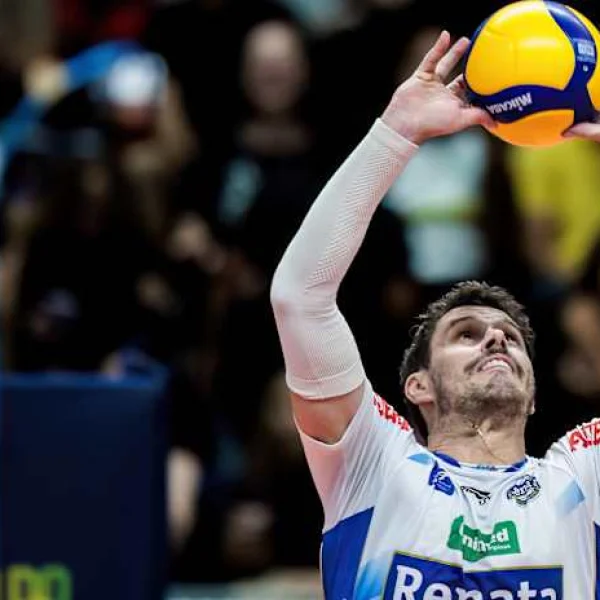
Bruno Mossa de Rezende, widely known as Bruninho, is a Brazilian setter whose senior career has combined long-term national-team leadership with championship success in Brazil and Italy. Born on July 2, 1986, in Rio de Janeiro, the 190 cm playmaker competed at five Olympic Games, winning silver medals at Beijing 2008 and London 2012 before captaining Brazil to gold on home soil at Rio 2016.
Bruno also won the 2010 World Championship, four editions of the FIVB World League, the 2021 Volleyball Nations League and two World Cups during nearly two decades with Brazil. His club career includes seven Brazilian league titles, an Italian championship with Modena, a Champions League–Italian league–Club World Championship run with Cucine Lube Civitanova and a return to Campinas that has produced a new group of trophies late in his career. He retired from international volleyball after Paris 2024 but remains an active professional and captain of Vôlei Renata in 2026.
Player Information
| Information | Details |
|---|---|
| Full Name | Bruno Mossa de Rezende |
| Known As | Bruninho |
| Date of Birth | July 2, 1986 |
| Place of Birth | Rio de Janeiro, Brazil |
| Nationality | Brazilian |
| Position | Setter |
| Height | 190 cm (6 ft 3 in) |
| Weight | 76 kg (168 lb) |
| Spike Reach | 323 cm — Rio 2016 roster listing |
| Block Reach | 302 cm — Rio 2016 roster listing |
| Dominant Hand | Right |
| Previous Clubs | Clube Fonte São Paulo; Unisul/Cimed; Cimed/Sky; Casa Modena; RJX; Modena Volley; SESI-SP; Cucine Lube Civitanova; EMS Taubaté Funvic |
| Current Club | Vôlei Renata / Campinas |
| Club Number | 1 |
| National Team | Brazil Men’s National Volleyball Team, 2006–2024 |
| National-Team Number | 1 |
| International Status | Retired from international volleyball after Paris 2024 |
| @bruninho1 |
The Brazilian Olympic Committee’s Paris 2024 guide lists Bruno at 190 cm and confirms both his full name and Rio de Janeiro birthplace, while an earlier COB guide gives his playing weight as 76 kg. His 323 cm spike reach and 302 cm block reach come from the Rio 2016 Olympic roster, so those reach measurements are best understood as documented historical competition data rather than newly measured 2026 figures.
Established player databases list Bruno as right-handed. His verified Instagram handle is also documented in the Brazilian Olympic Committee’s athlete materials, which list @bruninho1 alongside his other official social accounts.
Early Life & Volleyball Beginnings
Bruno was born into a family already deeply connected to Brazilian volleyball. His father, Bernardo “Bernardinho” Rezende, represented Brazil as a player before building a major coaching career, while his mother, Vera Mossa, was also a Brazilian international and Olympian. The family connection gave Bruno early exposure to high-level volleyball, including periods when he accompanied his father around professional teams.
Volleyball was not initially the only sport competing for his attention. The Brazilian Olympic Committee records that Bruno was a strong junior badminton player and competed successfully in South American and Pan-American events before committing fully to volleyball at around age 15. That background makes his development route somewhat different from a player who remained inside a single volleyball academy from childhood.
His early volleyball years were linked to Campinas. Vôlei Renata’s club record traces him through Clube Fonte São Paulo from 2000 to 2003 and then Unisul/Cimed from 2003 to 2005. He moved into Cimed’s senior structure and quickly became one of the leading young setters in Brazilian volleyball, winning the national league with Unisul in 2003–04 and then beginning a run of championships with Cimed.
By the middle of the decade, Bruno was already collecting Best Setter awards in the Brazilian Superliga. His rise at club level overlapped with his entry into Brazil’s senior national-team system, beginning the international career that would eventually make him one of the most experienced setters of his generation.
Club Career
Building a winning base in Brazil
Bruno’s first long senior phase was built in southern Brazil with Unisul and Cimed Florianópolis. He won the Brazilian championship with Unisul in 2003–04, then added four further national league titles with Cimed across the 2005–06, 2007–08, 2008–09 and 2009–10 seasons. Cimed also won the Brazilian Cup and the 2009 South American Club Championship during this period.
Those seasons established Bruno as more than a player benefiting from a successful roster. He repeatedly received Best Setter recognition in the Superliga, while his growing national-team role exposed him to another level of tactical responsibility and pressure.
His first experience in Italy came in an unusual form. In April 2011, Casa Modena signed him on a short contract after starting setter Mikko Esko suffered a season-ending injury. Bruno arrived for the closing round of the regular season and playoffs, wearing No. 6 during a brief spell that gave him his first direct experience of Italian club volleyball. His first Modena spell was therefore a short playoff assignment rather than a full-season transfer.
After returning to Brazil, Bruno continued with Cimed and then moved to RJX in Rio de Janeiro. RJX won the 2012–13 Brazilian league, giving him another championship with a different club and strengthening an already unusual record of domestic success across several team environments.
Modena and the move into Italy
A full European chapter began when Bruno joined Modena for 2014–15. This time he was not an emergency addition but one of the central pieces of a team built to compete for major Italian honors.
Modena won consecutive Coppa Italia titles in 2014–15 and 2015–16, the 2015 Italian Super Cup and the 2015–16 Italian championship. The league title was especially significant because it completed a season in which Bruno directed a powerful attack while also working within one of the highest-pressure club environments in European volleyball.
He returned to Brazil for 2016–17 with SESI-SP, then went back to Modena for 2017–18. These changes became a recurring pattern in his career: rather than remaining exclusively in Europe or Brazil, Bruno moved between both systems while continuing to play for the national team.
Cucine Lube Civitanova and the 2019 peak
Bruno joined Cucine Lube Civitanova in 2018, beginning one of the strongest club periods of his career. During the 2018–19 season, Lube won both the Italian championship and the CEV Champions League, giving Bruno his first European Champions League title.
The following December brought another major milestone at the FIVB Club World Championship in Brazil. Lube defeated Sada Cruzeiro in the final to complete a championship run, and Bruno was named both the tournament’s Best Setter and Most Valuable Player. Volleyball World’s Dream Team announcement identified him as the MVP of a Lube group that also placed several teammates among the individual award winners.

The award was particularly relevant for a setter because it recognized his influence on the whole offensive system rather than a large individual scoring total. Lube’s 2019 season ultimately produced an Italian league, Champions League and Club World Championship combination, one of the most complete title runs of Bruno’s club career.
Lube added the Coppa Italia in February 2020. Bruno again emphasized the team’s ability to remain tactically composed in a five-set final against Perugia, another match in which his decisions had to manage several high-volume attackers.
Taubaté and another return to Modena
Bruno returned to Brazil for 2020–21 with EMS Taubaté Funvic. The move produced another Brazilian championship as Taubaté defeated Minas in the Superliga final, giving Bruno his seventh Brazilian league title. FIVB described him as a key figure throughout the campaign and noted how effectively he distributed the offense in the title match. Taubaté’s 2021 Superliga title added another championship with a fourth Brazilian club.
He went back to Modena in 2021. The return reunited him with a club where he already had a long personal connection, dating not only to his earlier playing stints but also to childhood periods when his father had worked in Modena.
This third major Modena chapter lasted through the 2023–24 season. Its biggest international trophy came with the 2022–23 CEV Cup, adding another European competition to Bruno’s career record.
Returning to Campinas
In February 2024, Bruno announced that he would leave Italy and return to Brazil, describing the move as a decision to come closer to home during the final phase of his career. He joined Vôlei Renata in Campinas, the city where his volleyball path had started decades earlier. His decision to return to Brazil created a late-career chapter with a strong personal connection rather than simply another transfer.
The first season produced a 2024 Campeonato Paulista title and a place in the 2024–25 Superliga final. Vôlei Renata repeated as state champion in 2025, then made a much larger jump during 2025–26.
In March 2026, Campinas came back from two sets down against Sada Cruzeiro to win its first South American Club Championship. Bruno was named both MVP and Best Setter, and the championship was reported as the 50th title of his career. His 50th career title also secured Vôlei Renata a place at the 2026 Club World Championship.
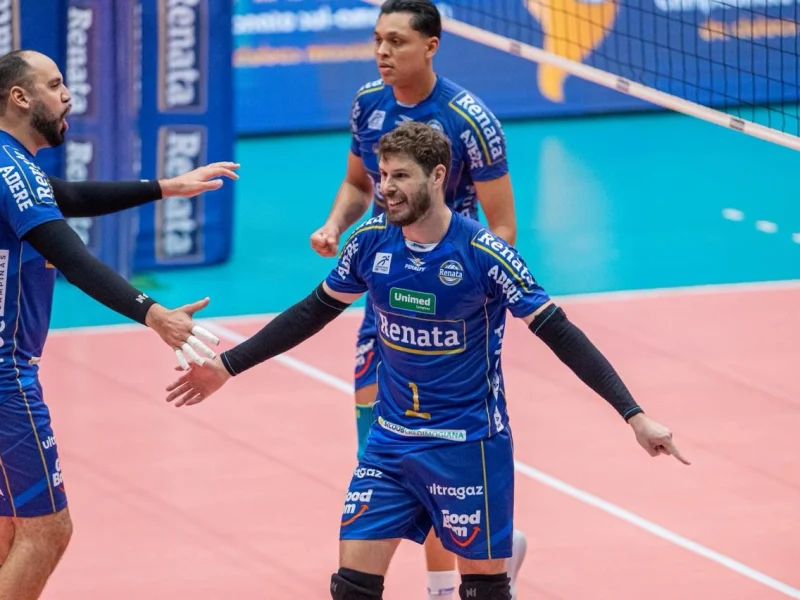
One week later, Vôlei Renata beat Cruzeiro again, this time 3–1 in the Copa Brasil final. Bruno received the match MVP award as Campinas won the first national cup title in the project’s history. The 2026 Copa Brasil final extended a period in which the setter was still shaping title matches at age 39.
Vôlei Renata reached another Superliga final in May 2026, losing to Cruzeiro, but Bruno was selected as the league’s Best Setter. In October, Campinas defeated Suzano to win a third consecutive Campeonato Paulista title, giving Bruno state championships in each of his first three seasons back with the club.
Club Career Timeline
| Seasons | Team | Country |
|---|---|---|
| 2000–2003 | Clube Fonte São Paulo | Brazil |
| 2003–2005 | Unisul/Cimed | Brazil |
| 2005–2012 | Cimed/Sky | Brazil |
| 2011 | Casa Modena — short playoff stint | Italy |
| 2012–2014 | RJX / RJ Vôlei | Brazil |
| 2014–2016 | Modena Volley | Italy |
| 2016–2017 | SESI-SP | Brazil |
| 2017–2018 | Modena Volley | Italy |
| 2018–2020 | Cucine Lube Civitanova | Italy |
| 2020–2021 | EMS Taubaté Funvic | Brazil |
| 2021–2024 | Modena Volley | Italy |
| 2024–present | Vôlei Renata / Campinas | Brazil |
Vôlei Renata’s official career summary supplies the main club chronology, while contemporary reporting confirms that Bruno’s first Modena experience was a short 2011 playoff transfer during his longer Cimed period.
National Team Career
Breaking into a championship generation
Bruno entered Brazil’s senior setup while the country was still in the middle of one of the strongest eras in men’s international volleyball. He was part of the program by the 2006 World League and soon moved from a young reserve into a regular setter as the roster evolved.
Brazil won World League titles in 2006, 2007, 2009 and 2010 during his early international years. Bruno also collected gold at the 2007 World Cup and 2007 Pan American Games before making his Olympic debut in Beijing in 2008, where Brazil took silver.
Two years later, Brazil won the 2010 FIVB World Championship in Italy. By the London 2012 Olympics, Bruno was operating with far greater responsibility, and Brazil again reached the final before losing to Russia after leading by two sets. He has since spoken publicly about the impact of that defeat and how it became an important turning point in his career.
Captaincy and Rio 2016
The post-London period changed Bruno’s role within Brazil. As several players from the previous Olympic championship generation left the team, he became one of the central veteran voices in the squad.
In an interview with Volleyball World, Bruno explained that his leadership responsibilities grew after 2012 and that Brazil continued to operate with several leaders rather than relying on one voice. He identified Rio 2016 as the tournament where that responsibility felt strongest because the team had to manage intense pressure throughout the home Olympics. His Volleyball World leadership interview gives unusually direct evidence of how he understood the captain’s role.
Brazil’s Rio campaign was difficult early, but the team reached the knockout rounds and eventually defeated Italy in the Olympic final. Bruno became an Olympic champion and was named Best Setter of the tournament. The gold completed a sequence of three consecutive Olympic medals for him after the silvers of Beijing and London.
World medals, World Cup gold and VNL success
Brazil remained a major medal contender after Rio. Bruno was part of the team that earned silver at the 2018 World Championship, then won the 2019 World Cup. His club season that year also ended with the Club World Championship MVP award, making 2019 one of the strongest combined national-team and club years of his career.
The launch of the Volleyball Nations League created another target. Brazil won the competition for the first time in 2021, with Bruno serving as setter and captain. Volleyball World later highlighted that VNL title alongside his leadership of Brazil to another Olympic semifinal at Tokyo.
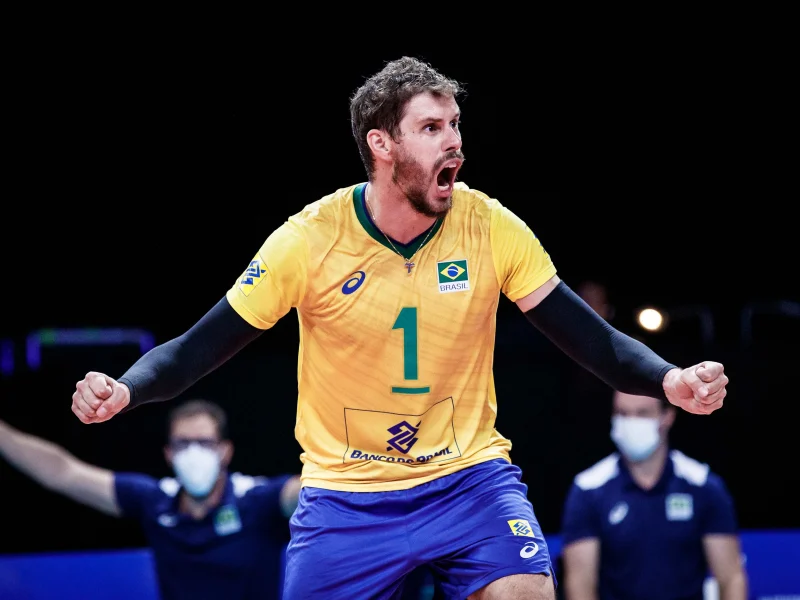
Tokyo also carried a wider Olympic distinction. Bruno and judoka Ketleyn Quadros were selected as Brazil’s flag bearers at the opening ceremony, with Bruno becoming the first indoor volleyball player to carry the Brazilian flag in that role. His Tokyo flag-bearer selection reflected his standing beyond the volleyball team itself.
Brazil finished fourth in Tokyo but returned to the World Championship podium in 2022, beating Slovenia for bronze. Bruno remained captain during the tournament and contributed from both the setting position and the service line in the medal match.
Paris 2024 and the end of his international career
Bruno reached a fifth Olympic Games at Paris 2024. At 38, he was again captain and one of three Rio 2016 Olympic champions on Brazil’s roster alongside Ricardo Lucarelli and Lucas Saatkamp.
Brazil advanced to the quarterfinals but was eliminated by the United States. Immediately after the defeat, Bruno said it was “very probably” his final match for the national team, and the following seasons confirmed the transition.
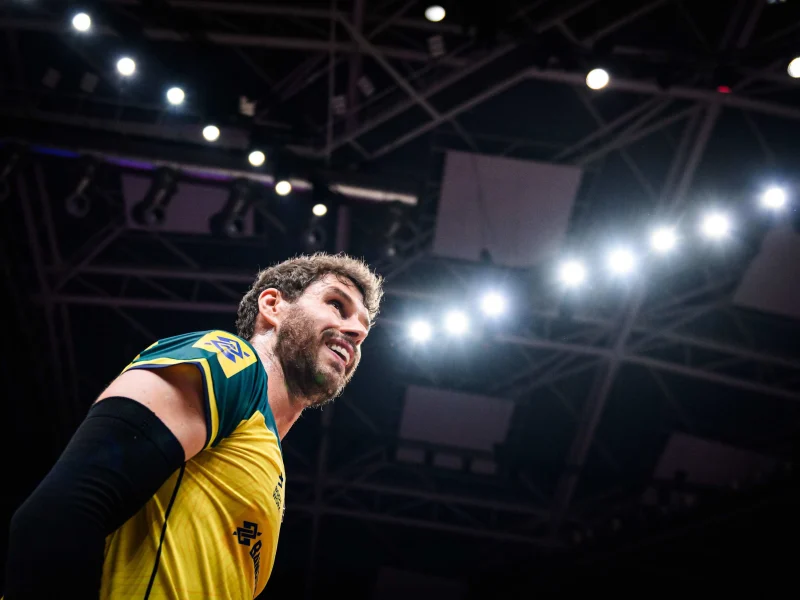
By 2025, Brazilian reporting described his national-team retirement as settled, with Fernando Cachopa taking over the primary setter role. Bruno used the first international break of his professional career to spend more time away from the annual national-team schedule.
His international record therefore spans roughly two decades and five Olympics: silver at Beijing 2008, silver at London 2012, gold at Rio 2016, fourth place at Tokyo 2020 and a quarterfinal exit at Paris 2024. That career also included World Championship gold, two additional World Championship silvers, bronze in 2022, four World League titles, the 2021 VNL title and World Cup victories in 2007 and 2019.
Playing Style & Strengths
Bruno’s career has been built around distribution speed, communication and an ability to manage very different groups of attackers. The strongest evidence is the range of successful systems he has directed: title-winning Brazilian teams, Modena lineups in Italy, Lube’s 2019 European and world championship roster, and multiple generations of Brazil’s national team.
His setting is not defined by feeding one terminal scorer repeatedly. Bruno has spent much of his career with teams that offered several high-level attacking options, and his value has been in keeping those options connected to the offense. During Taubaté’s 2021 Superliga title run, FIVB specifically noted how he used his scoring options while Douglas Souza and Maurício Borges carried much of the attacking load.
Tempo with the middle attack has also been important. Bruno is capable of playing quickly enough to keep opposing blockers committed in the center, then opening one-on-one or broken-block situations for the pins. That type of distribution becomes especially valuable on teams with multiple high-level attackers because the setter’s job is less about identifying an obvious first option and more about controlling which blocker has to move.
His individual awards reinforce that pattern across different career stages. He was named Best Setter in several early Brazilian Superliga seasons, Best Setter at Rio 2016, Best Setter and MVP of the 2019 Club World Championship, MVP of the 2021 South American Championship and, at age 39, MVP and Best Setter of the 2026 South American Club Championship.
Bruno has also brought a strong competitive personality to the position. Volleyball World’s account of his leadership describes a player who became more influential as Brazil’s older championship generation retired after London 2012. His role was not limited to tactical calls; he was often the player responsible for setting emotional rhythm during difficult stretches of major tournaments.
Serving has periodically added another layer. He was named Best Server at the 2007 South American Championship, and even later in his career he remained willing to use serving pressure rather than simply put the ball safely in play. As with many veteran setters, however, his primary influence comes from decisions made before the attack: reading reception quality, identifying blocker position, varying tempo and keeping enough hitters involved that opponents cannot settle into one defensive pattern.
Major Achievements
Bruno’s trophy record stretches from his first Brazilian league title as a teenager to major club championships won after turning 39. The selections below focus on his strongest senior team honors and individual awards rather than every state, invitational and secondary competition.
Selected National Team Honors
| Year | Competition | Result |
|---|---|---|
| 2006 | FIVB World League | Gold |
| 2007 | FIVB World League | Gold |
| 2007 | FIVB World Cup | Gold |
| 2007 | Pan American Games | Gold |
| 2008 | Olympic Games | Silver |
| 2009 | FIVB World League | Gold |
| 2009 | FIVB World Grand Champions Cup | Gold |
| 2010 | FIVB World League | Gold |
| 2010 | FIVB World Championship | Gold |
| 2011 | Pan American Games | Gold |
| 2012 | Olympic Games | Silver |
| 2013 | FIVB World Grand Champions Cup | Gold |
| 2014 | FIVB World Championship | Silver |
| 2016 | Olympic Games | Gold |
| 2017 | FIVB World Grand Champions Cup | Gold |
| 2018 | FIVB World Championship | Silver |
| 2019 | FIVB World Cup | Gold |
| 2021 | Volleyball Nations League | Gold |
| 2021 | South American Championship | Gold |
| 2022 | FIVB World Championship | Bronze |
Volleyball World summarizes the same championship core with four World League titles, three World Grand Champions Cup victories, two World Cups and the 2021 VNL title, in addition to Bruno’s Olympic and World Championship medals.
Selected Club Honors
| Year / Season | Team | Competition | Result |
|---|---|---|---|
| 2003–04 | Unisul/Cimed | Brazilian Superliga | Champion |
| 2005–06 | Cimed Florianópolis | Brazilian Superliga | Champion |
| 2007–08 | Cimed Florianópolis | Brazilian Superliga | Champion |
| 2008–09 | Cimed Florianópolis | Brazilian Superliga | Champion |
| 2009 | Cimed Florianópolis | South American Club Championship | Champion |
| 2009–10 | Cimed Florianópolis | Brazilian Superliga | Champion |
| 2012–13 | RJX | Brazilian Superliga | Champion |
| 2014–15 | Modena Volley | Coppa Italia | Winner |
| 2015–16 | Modena Volley | Italian SuperLega | Champion |
| 2015–16 | Modena Volley | Coppa Italia | Winner |
| 2018–19 | Cucine Lube Civitanova | CEV Champions League | Champion |
| 2018–19 | Cucine Lube Civitanova | Italian SuperLega | Champion |
| 2019 | Cucine Lube Civitanova | FIVB Club World Championship | Champion |
| 2019–20 | Cucine Lube Civitanova | Coppa Italia | Winner |
| 2020–21 | EMS Taubaté Funvic | Brazilian Superliga | Champion |
| 2022–23 | Modena Volley | CEV Cup | Champion |
| 2024 | Vôlei Renata | Campeonato Paulista | Champion |
| 2025 | Vôlei Renata | Campeonato Paulista | Champion |
| 2026 | Vôlei Renata | South American Club Championship | Champion |
| 2026 | Vôlei Renata | Copa Brasil | Champion |
| 2026 | Vôlei Renata | Campeonato Paulista | Champion |
Vôlei Renata’s official career record documents the core championships across Bruno’s Brazilian and Italian club periods, while the 2026 continental, cup and state titles extend that record into his forties.
Selected Individual Awards
| Year / Season | Competition | Award |
|---|---|---|
| 2005–06 | Brazilian Superliga | Best Setter |
| 2006–07 | Brazilian Superliga | Best Setter |
| 2007 | Copa América | Best Setter |
| 2007 | South American Championship | Best Server |
| 2007–08 | Brazilian Superliga | Best Setter |
| 2008–09 | Brazilian Superliga | Best Setter |
| 2009 | World Grand Champions Cup | Best Setter |
| 2011 | Pan American Games | Best Setter |
| 2013 | FIVB World League | Best Setter |
| 2016 | Olympic Games | Best Setter |
| 2019 | FIVB Club World Championship | MVP |
| 2019 | FIVB Club World Championship | Best Setter |
| 2021 | South American Championship | MVP |
| 2021 | South American Championship | Best Setter |
| 2026 | South American Club Championship | MVP |
| 2026 | South American Club Championship | Best Setter |
| 2025–26 | Brazilian Superliga | Best Setter |
His 2019 Club World Championship MVP is one of the strongest individual marks because setters rarely lead major-event MVP voting. Six years later, his 2026 South American Club Championship MVP showed that he was still receiving top individual recognition deep into the final phase of his career.
Family & Personal Life
Bruno’s volleyball background is closely connected to his parents. Bernardinho played setter for Brazil before becoming a high-profile coach, while Vera Mossa represented the Brazilian women’s national team and competed at the Olympic level. Bruno has therefore spent much of his career operating inside a family already associated with elite international volleyball.
That connection also created unusual professional circumstances. Bernardinho coached his son with the Brazilian national team for years, including during the Rio 2016 Olympic title run. Bruno’s career, however, developed across clubs and national-team cycles long enough to establish an identity independent of that family relationship, including championship seasons under several different club coaches in Brazil and Italy.
His early relationship with sport extended beyond volleyball. As a teenager he played competitive badminton before choosing volleyball full-time, a detail that remained part of his official Brazilian Olympic biography years later.
Off the Court
In 2025, Bruno released a Portuguese-language biography titled Entre Sombras e Vitórias. The book revisits both championship moments and more difficult periods of his career, with the London 2012 Olympic final serving as an important point in the story. In interviews around the launch, he discussed vulnerability, pressure and the importance of taking care of his mental well-being rather than presenting an athlete’s career only through medals and trophies. His 2025 biography interview provides a more personal account of those experiences.
His public work expanded again in 2026 when Volleyball World used Bruno as the host of its ROTATIONS series. The season finale brought him together with Brazil women’s captain Gabi Guimarães and singer Thiaguinho for a conversation centered on leadership, career decisions and representing Brazil.
These projects fit the stage of his career after retiring from international competition: Bruno remains an active player, but his public role increasingly includes discussing leadership and the experiences accumulated across two decades at the top level.
Where Is Bruno Rezende Playing Now?
As of November 11, 2026, Bruno is the setter and captain of Vôlei Renata / Campinas, wearing No. 1. He returned to the Campinas project in 2024 and agreed to another two-season extension in April 2026. His two-season renewal makes the club the clear center of the final stage of his playing career.
The 2026–27 season began with another title. Campinas defeated Suzano in October to win the Campeonato Paulista for the third consecutive year, finishing the second final with a remarkable 34–32 fifth set.
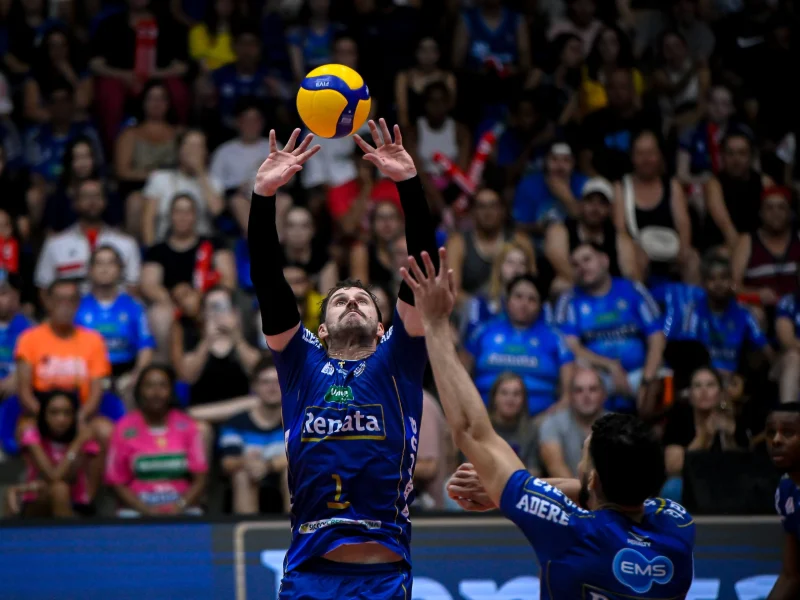
The team then opened the Superliga with three consecutive victories. Bruno missed the November 9 win over Sesi Bauru after suffering a calf strain during training earlier that day, with reserve setter Cris taking over the starting role.
His club schedule also carries an international target: the 2026 South American title qualified Vôlei Renata for the FIVB Club World Championship. Bruno therefore remains involved in top-level domestic and international club competition even though his Brazil national-team career has ended.
Recent Performance Snapshot
The 2026 season has added several important late-career results to Bruno’s record.
| Date / Competition | Result / Recognition |
|---|---|
| March 2026 — South American Club Championship | Champion with Vôlei Renata; MVP and Best Setter; 50th career title |
| March 2026 — Copa Brasil | Champion; match MVP in the final against Sada Cruzeiro |
| May 2026 — Brazilian Superliga | Runner-up with Vôlei Renata; selected Best Setter |
| October 2026 — Campeonato Paulista | Champion; third consecutive state title with Campinas |
| November 2026 — Brazilian Superliga | Vôlei Renata opened 3–0; Bruno missed the third match with a calf strain |
The South American championship was the standout individual moment. Campinas recovered from a 2–0 deficit against Sada Cruzeiro in the final, and Bruno’s distribution across the comeback earned him both the setter award and tournament MVP.
His Superliga Best Setter award is another useful measure of current level. It came in a season when Vôlei Renata reached the national final for a third consecutive year, showing that his late-career role is still based on being the team’s primary setter rather than simply providing veteran depth.
Frequently Asked Questions
How old is Bruno Rezende?
Bruno Rezende was born on July 2, 1986, in Rio de Janeiro. He turned 40 in July 2026.
How tall is Bruno Rezende?
Bruno is listed at 190 cm, or approximately 6 ft 3 in, by the Brazilian Olympic Committee and Volleyball World.
What position does Bruno Rezende play?
Bruno is a setter. He has played the position throughout his senior club and international career and currently wears No. 1 for Vôlei Renata.
Which club does Bruno Rezende play for?
Bruno currently plays for Vôlei Renata / Campinas in Brazil. He returned to the club in 2024 and renewed for two additional seasons in April 2026.
Did Bruno Rezende retire?
Bruno retired from the Brazil men’s national team after the Paris 2024 Olympics, but he did not retire from professional volleyball. He remains an active club player with Vôlei Renata.
How many Olympics did Bruno Rezende play?
Bruno competed at five Olympic Games: Beijing 2008, London 2012, Rio 2016, Tokyo 2020 and Paris 2024. He won silver in 2008 and 2012 and gold in 2016.
How many Olympic medals did Bruno Rezende win?
He won three Olympic medals with Brazil: two silver medals and one gold. Rio 2016 was his only Olympic championship and also brought him the tournament’s Best Setter award.
References
- Vôlei Renata — Bruninho official player profile and career record
- Brazilian Olympic Committee — Paris 2024 Team Brazil athlete guide
- Volleyball World — Winning never gets old for Bruno
- Volleyball World — Lube dominate the 2019 Club World Championship Dream Team
- FIVB — Taubaté claim the 2021 Brazilian Superliga
- Volleyball World — Bruno selected as Brazil’s Tokyo Olympic flag bearer
- FIVB — Renata win the 2026 South American Club Championship
- Brazilian Volleyball Confederation — Vôlei Renata win the 2026 Copa Brasil
- ge — Bruninho renews with Campinas for two more seasons
- ge — Bruninho wins 50th career title and South American MVP
- ge — Bruninho discusses Entre Sombras e Vitórias and his career
- Volleybox — Bruno Rezende player data and dominant hand