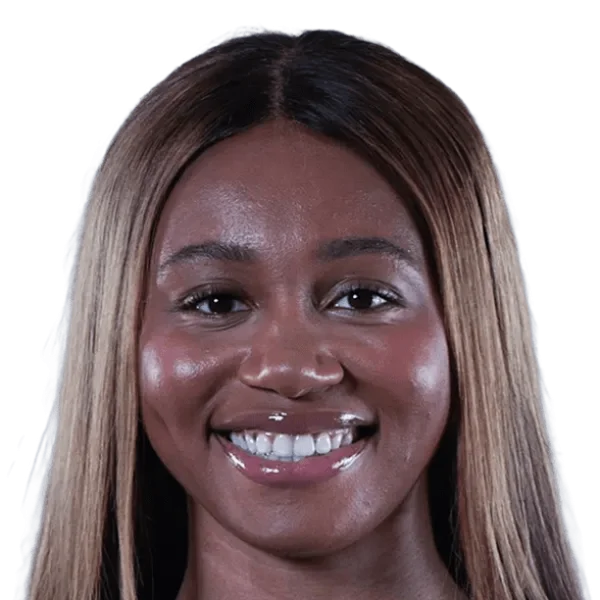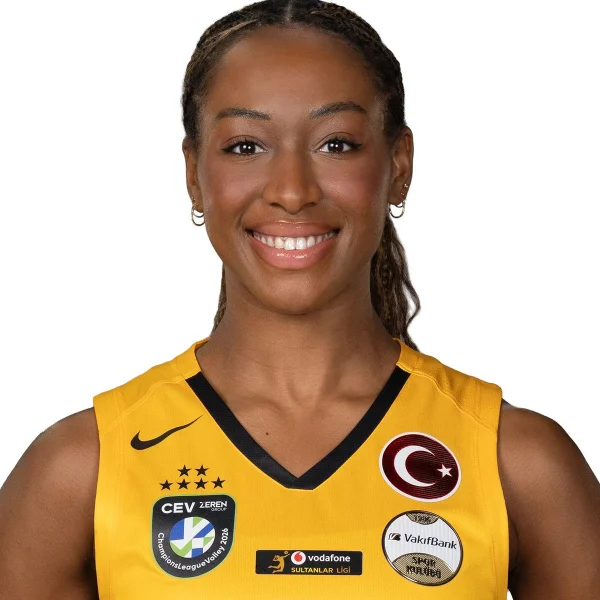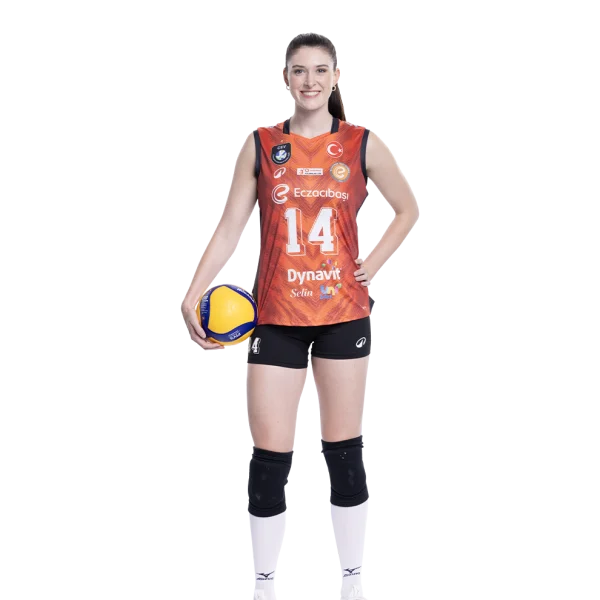
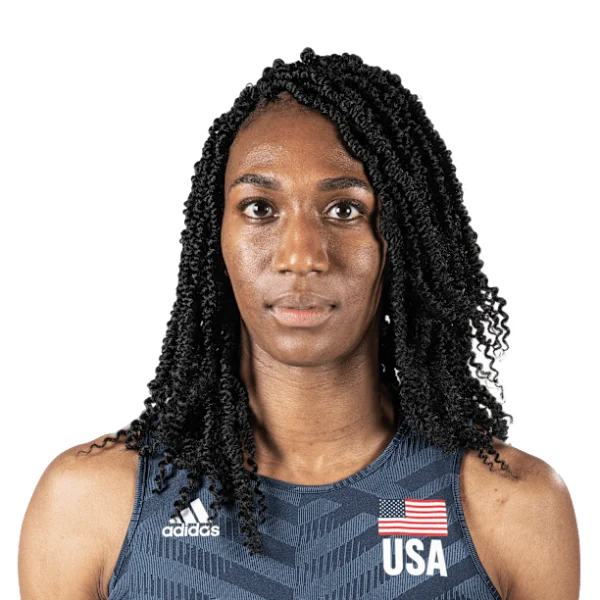
Foluke Akinradewo Gunderson is a retired American middle blocker whose career connected three generations of the United States women’s national team. A 191 cm middle with elite attacking efficiency and blocking range, she won Olympic silver in London in 2012, bronze in Rio in 2016 and gold at Tokyo 2020, completing the full Olympic medal set across three Games.
Her international résumé also includes the United States’ first FIVB World Championship gold in 2014, multiple World Grand Prix titles and the inaugural Volleyball Nations League title in 2018. At club level, she built a career across Japan, Russia, Azerbaijan and Switzerland before finishing with Hisamitsu Springs, while her college career at Stanford produced one of the most efficient attacking records in NCAA women’s volleyball.
Akinradewo’s later years added another dimension to that record. After stepping away from competition to have her first child, she returned to professional volleyball and then to Team USA, ultimately helping the Americans win their first Olympic women’s volleyball gold medal in Tokyo. In 2026, USA Volleyball inducted her as an All-Time Great Female Indoor Athlete.
Player Information
| Field | Detail |
|---|---|
| Full Name | Foluke Atinuke Akinradewo Gunderson |
| Known As | Foluke Akinradewo |
| Date of Birth | October 5, 1987 |
| Place of Birth | London, Ontario, Canada |
| Nationality / Citizenship | United States; also holds Canadian and Nigerian citizenship |
| Position | Middle Blocker |
| Height | 191 cm (6 ft 3 in) |
| Weight | 79 kg |
| Spike Reach | 331 cm |
| Block Reach | 300 cm |
| Dominant Hand | Right |
| College | Stanford University — Human Biology |
| College Career | Stanford Cardinal, 2005–2008 |
| Previous Clubs | Toyota Auto Body Queenseis, Dinamo Krasnodar, Rabita Baku, Voléro Zürich, Hisamitsu Springs |
| Current Club | None — retired |
| National Team | United States Women’s National Volleyball Team |
| Senior National Team Period | 2005–2021 |
| National Team Number | 16 |
| Olympic Games | London 2012, Rio 2016, Tokyo 2020 |
| Career Status | Retired |
| @folukea |
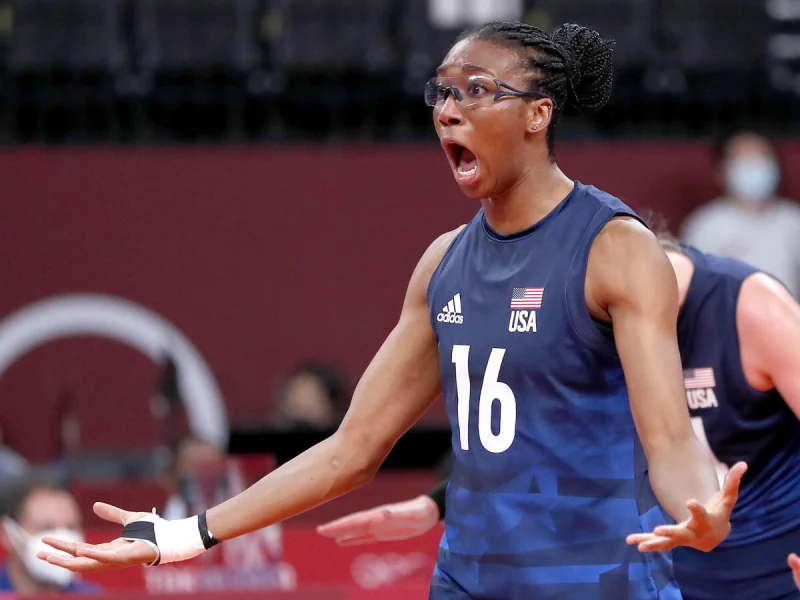
Official Olympic and CEV records consistently list Akinradewo at 191 cm and 79 kg, with a 331 cm spike reach and 300 cm block reach. The Tokyo roster also records her as right-handed and wearing No. 16 for the United States.
Early Life & Volleyball Beginnings
Akinradewo was born in London, Ontario, to Nigerian parents Ayoola and Comfort Akinradewo and grew up largely in the United States, including in Florida. Her sporting background was unusually broad: before Stanford, she competed not only in volleyball but also in basketball and track and field, and she did not follow the conventional elite American club-volleyball route as a teenager.
That did not prevent an early international breakthrough. USA Volleyball records that she made her senior international debut in the summer of 2005, before beginning college, after also representing the United States at junior level. Her combination of length, coordination and explosiveness quickly translated to the middle-blocker position.
Stanford became the setting where those physical tools developed into elite production. From 2005 through 2008, Akinradewo was an AVCA All-American in all four seasons, earning first-team recognition in her final three years. As a junior in 2007, she was named AVCA National Player of the Year, won the Honda Award for volleyball and hit .499 for the season.
Her college numbers remain striking even against Stanford’s long history of elite players. Stanford’s official record book lists Akinradewo first in program career hitting percentage at .446, and her playing biography records 1,682 career kills and 579 total blocks. She finished her senior year with 173 blocks and a .457 hitting percentage. Stanford’s career records continue to list her .446 mark atop the program’s career hitting-percentage table.
Club Career
After Stanford, Akinradewo developed into a genuinely international professional. Her career took her from Japan to Russia, then through major clubs in Azerbaijan and Switzerland before she returned to Japan for the longest club relationship of her career.
Club Career Timeline
| Seasons | Team | Country |
|---|---|---|
| 2010–11 | Toyota Auto Body Queenseis | Japan |
| 2011–12 | Dinamo Krasnodar | Russia |
| 2012–15 | Rabita Baku | Azerbaijan |
| 2015–17 | Voléro Zürich | Switzerland |
| 2017–19 | Hisamitsu Springs | Japan |
| 2020–22 | Hisamitsu Springs | Japan |
The sequence is supported by her international club records and later FIVB coverage of her return to Hisamitsu. Her first Hisamitsu period ended when she stepped away from volleyball to have her son, before she rejoined the Japanese club for the 2020–21 season and remained through its 2022 title run.
Success in Azerbaijan and Switzerland
Rabita Baku gave Akinradewo a sustained run in one of Europe’s strongest club environments of the period. FIVB later credited her Azerbaijan years with three national titles, while CEV competition records document her presence with Rabita in Champions League competition.
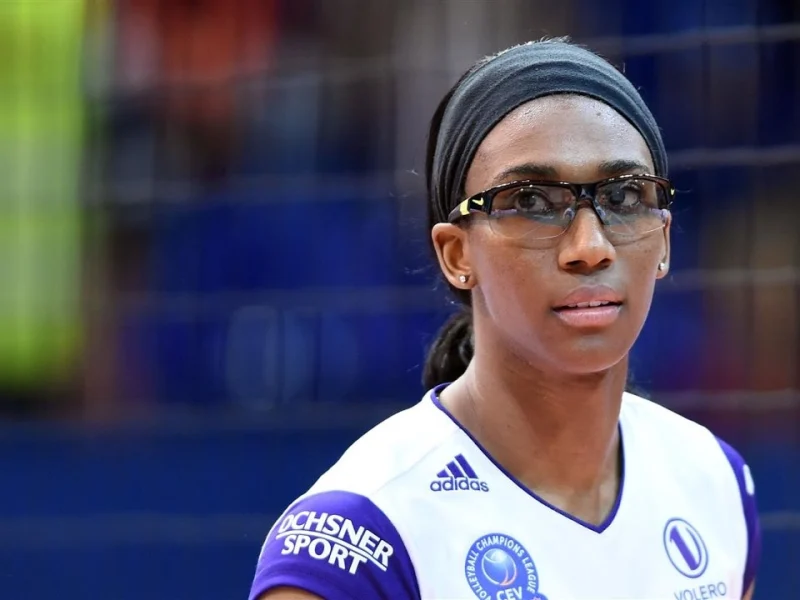
She moved to Voléro Zürich in 2015, adding another two domestic championships during her time in Switzerland. The move kept her in Champions League-level competition while bridging the period between the London and Rio Olympic cycles. CEV’s Voléro roster records list Akinradewo at middle blocker with the same 191 cm, 79 kg and 331/300 cm physical profile found in her other international records.
Hisamitsu Springs and a second career chapter
Akinradewo joined Hisamitsu Springs in 2017 and immediately became part of championship teams in Japan. Hisamitsu won consecutive league titles in 2017–18 and 2018–19, and Akinradewo was named MVP after the second championship season; the club also won the Empress Cup during that period.
Her return after motherhood turned Hisamitsu into more than another stop on the career timeline. FIVB’s 2020 comeback report documented her decision to return to the same club after taking time away from the sport, giving her a familiar environment in which to rebuild toward international competition.
The final documented season showed that the comeback was not simply symbolic. Hisamitsu won the 2021 Empress Cup, with Akinradewo scoring 21 points in the final, and then captured the 2021–22 V.League championship. In the league title match against JT Marvelous, she produced 25 points on 20 kills and five blocks and was named Best Spiker.
National Team Career
Akinradewo’s senior U.S. career began in 2005 and eventually covered three Olympics, multiple coaching eras and some of the most important milestones in American women’s volleyball history. Before becoming an Olympian herself, she was an alternate for the 2008 Olympic team.
Her first major individual international breakthrough came at the 2010 FIVB World Grand Prix, where the United States won gold and Akinradewo was named both tournament MVP and Best Blocker. Those awards established her not merely as a promising American middle but as one of the leading players at her position internationally.
London 2012 brought her first Olympic medal as the United States finished second. Two years later, she was part of the American team that won the 2014 FIVB Women’s World Championship, the first world championship title in U.S. women’s program history.
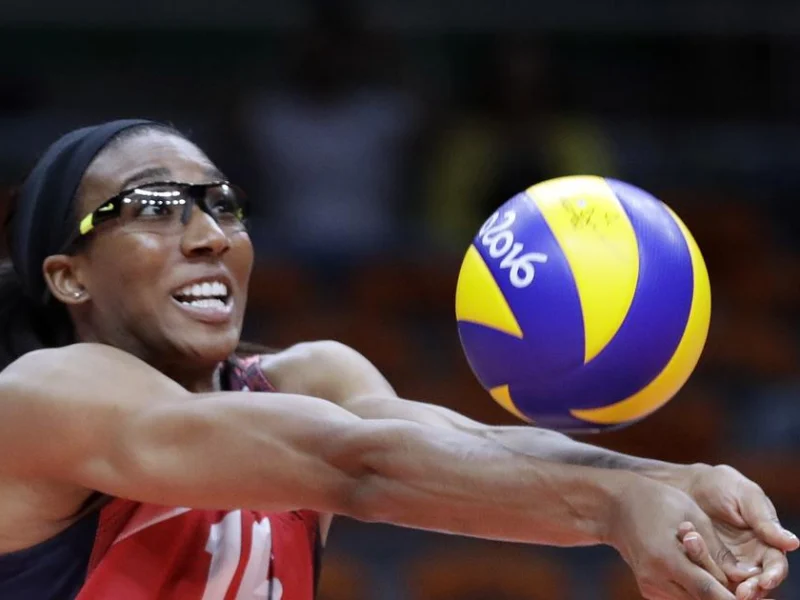
At Rio 2016, the United States recovered from its semifinal defeat to take bronze, and Akinradewo’s individual performance was recognized on the tournament Dream Team. The official Rio results book named her one of the two Best Middle Blockers of the Olympic tournament. The Rio 2016 official results book records both the U.S. bronze medal and Akinradewo’s Dream Team selection.
She remained an important part of the next U.S. cycle, including the team that won the inaugural Volleyball Nations League in 2018. USA Volleyball’s 2018 World Championship material recorded a .389 hitting efficiency during that VNL campaign and 0.55 blocks per set, numbers that reflected the two-way value she had provided throughout her international career.
Motherhood, comeback and Tokyo gold
Akinradewo stepped away from volleyball after the 2018 international season and gave birth to her son, Olukayode Ayodele, in 2019. Her return required rebuilding after pregnancy-related diastasis recti, a process she discussed publicly while emphasizing the support required to combine motherhood and professional sport.
She first returned with Hisamitsu and then rejoined the U.S. national team at the 2021 Volleyball Nations League after more than two years away. Volleyball World’s feature on her national-team comeback described both the uncertainty she had faced and the work required to return to international level.
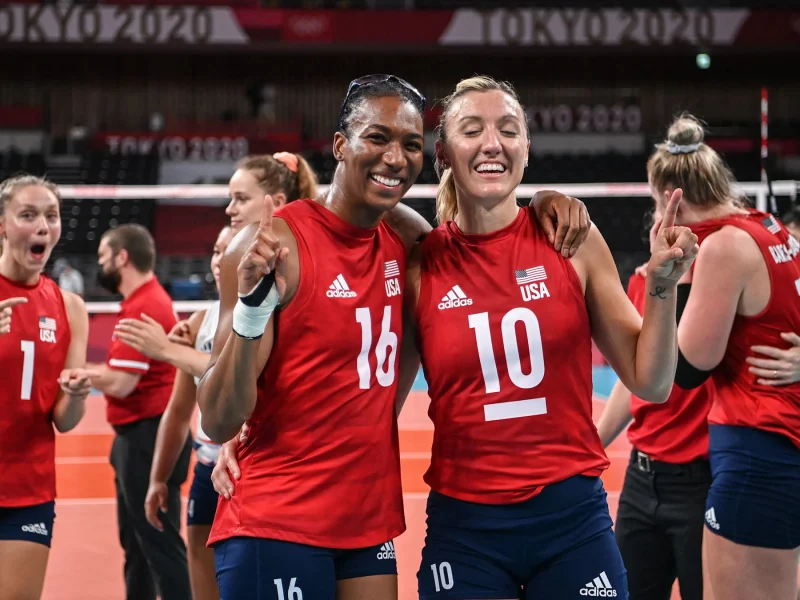
Tokyo completed the arc. The United States won its first Olympic gold medal in women’s indoor volleyball, giving Akinradewo a third medal in three Olympic appearances: silver in 2012, bronze in 2016 and gold in 2020. Only a small group of U.S. women have appeared at three or more Olympics, and Akinradewo is one of the program’s multi-medal Olympians.
Playing Style & Strengths
Akinradewo’s career numbers point first to attacking efficiency. Middle blockers often work on a lower volume of swings than pin attackers, but the position demands fast footwork, precise timing with the setter and the ability to score before a block can become fully established. Her Stanford career hit rate of .446, including a .499 junior season, showed how consistently she converted those quick-tempo opportunities.
Her physical profile added unusual range to that efficiency. At 191 cm with a listed 331 cm spike reach, she had the reach to attack above many opposing blocks without being unusually tall for an international middle. That combination of reach and speed made her especially effective when the offense could establish her as a legitimate first-tempo threat.
Blocking was the other defining half of her position. Akinradewo was not simply a stationary size matchup at the net; her effectiveness depended on reading the setter, closing space with the pin blockers and turning those reads into controlled penetration over the net. Her 579 collegiate blocks, 2010 World Grand Prix Best Blocker award and 2016 Olympic Best Middle Blocker honor provide evidence across different stages of her career.
She also understood the middle blocker as a connective position rather than an individual scoring role. On her USA Volleyball profile, Akinradewo emphasized communication with the outside blockers and the offensive value of drawing the opposing block away from her team’s pin attackers. That description fits the wider tactical value of her career: even when she did not receive the set, her movement through the middle could shape the block facing the rest of the U.S. offense.
Major Achievements
Selected National Team Honors
| Year | Competition | Result |
|---|---|---|
| 2010 | FIVB World Grand Prix | Gold |
| 2011 | FIVB World Grand Prix | Gold |
| 2011 | FIVB World Cup | Silver |
| 2012 | Olympic Games | Silver |
| 2014 | FIVB Women’s World Championship | Gold |
| 2015 | FIVB World Grand Prix | Gold |
| 2015 | FIVB World Cup | Bronze |
| 2016 | Olympic Games | Bronze |
| 2018 | FIVB Volleyball Nations League | Gold |
| 2021 | FIVB Volleyball Nations League | Gold |
| 2021 | Tokyo 2020 Olympic Games | Gold |
Her Olympic medals form the clearest summary of the length of that international career: one silver, one bronze and one gold across three consecutive appearances. USA Volleyball’s current Olympic history lists Akinradewo among its three-time Olympians and multi-medal players.
Selected Club Honors
| Season / Year | Team | Competition | Result |
|---|---|---|---|
| 2010s | Rabita Baku | Azerbaijan national championship | Three titles during her tenure |
| 2015–17 | Voléro Zürich | Swiss championship | Two titles during her tenure |
| 2017–18 | Hisamitsu Springs | Japanese V.League | Champion |
| 2018–19 | Hisamitsu Springs | Japanese V.League | Champion |
| 2018–19 | Hisamitsu Springs | Empress Cup | Champion |
| 2021 | Hisamitsu Springs | Empress Cup | Champion |
| 2021–22 | Hisamitsu Springs | Japanese V.League | Champion |
FIVB’s career summary credits her with the three Azerbaijan titles, two Swiss championships and the first two Japanese league championships, while USA Volleyball documented both the 2021 Empress Cup and 2022 V.League victories after her return.
Selected Individual Awards
| Year / Season | Competition | Award |
|---|---|---|
| 2005 | Pac-10 | Freshman of the Year |
| 2007 | NCAA / AVCA | National Player of the Year |
| 2007 | Collegiate volleyball | Honda Award |
| 2007 | Pac-10 | Player of the Year |
| 2008 | Pac-10 | Player of the Year |
| 2008 | Volleyball Magazine | Co-National Player of the Year |
| 2010 | FIVB World Grand Prix | MVP |
| 2010 | FIVB World Grand Prix | Best Blocker |
| 2016 | Olympic Games | Best Middle Blocker / Dream Team |
| 2018–19 | Japanese V.League | MVP |
| 2021–22 | Japanese V.League | Best Spiker |
| 2026 | USA Volleyball Hall of Fame | All-Time Great Female Indoor Athlete |
The 2026 honor formalized her place in U.S. volleyball history. USA Volleyball described Akinradewo Gunderson as one of the most decorated middle blockers in U.S. history when announcing her induction.
Personal Life & Family
Akinradewo’s background spans three countries. She was born in Canada to Nigerian parents, represented the United States internationally and has publicly been described by USA Volleyball as holding citizenship in all three countries. She has two brothers, Folu and Foluso, both of whom also competed in track and field.
At Stanford she majored in human biology, an academic path that remained relevant well beyond college. USA Volleyball has also noted that she became a certified EMT and had long expressed an interest in pursuing work in medicine after her volleyball career.
She married Jonathan Gunderson in 2018, and their son Kayode was born in 2019. Becoming a mother became one of the most consequential personal and athletic transitions of her career, because her subsequent rehabilitation led all the way back to international volleyball and an Olympic gold medal.
Where Is Foluke Akinradewo Playing Now?
Akinradewo is retired from professional and international volleyball. Her last documented professional season came with Hisamitsu Springs in 2021–22, ending with a Japanese league championship and Best Spiker recognition, while her final U.S. national-team cycle culminated in VNL and Olympic gold in 2021.
Her playing career has since shifted into legacy recognition and life beyond elite sport. USA Volleyball inducted her into its Hall of Fame as an All-Time Great Female Indoor Athlete in May 2026, alongside a class of prominent indoor, beach and sitting-volleyball figures. USA Volleyball’s 2026 Hall of Fame record lists Akinradewo Gunderson among the year’s inductees.
She has also continued the medical interest that was visible during her Stanford and national-team years. In an April 2026 episode of The USA Volleyball Show, Akinradewo discussed her family and life since retirement, with the episode description noting that she was preparing to begin nursing school.
Frequently Asked Questions
What position did Foluke Akinradewo play?
Foluke Akinradewo was a middle blocker. She played the position throughout her Stanford, professional and United States national-team career.
How tall is Foluke Akinradewo?
Akinradewo is officially listed at 191 cm (6 ft 3 in). International competition records list her at 79 kg with a 331 cm spike reach and 300 cm block reach.
How many Olympic medals did Foluke Akinradewo win?
She won three Olympic medals: silver at London 2012, bronze at Rio 2016 and gold at Tokyo 2020. That gives her one medal of each color.
Did Foluke Akinradewo win an Olympic gold medal?
Yes. Akinradewo was part of the United States team that won gold at Tokyo 2020, the first Olympic women’s indoor volleyball gold medal in U.S. program history.
Which clubs did Foluke Akinradewo play for?
Her professional career included Toyota Auto Body Queenseis in Japan, Dinamo Krasnodar in Russia, Rabita Baku in Azerbaijan, Voléro Zürich in Switzerland and Hisamitsu Springs in Japan.
Did Foluke Akinradewo return to volleyball after having a child?
Yes. She stepped away from competition around the birth of her son in 2019, returned to Hisamitsu Springs in 2020 and rejoined the U.S. national team in 2021 before winning Olympic gold in Tokyo.
Is Foluke Akinradewo retired?
Yes. She is retired from elite volleyball. Her post-retirement status was discussed in the 2026 USA Volleyball Show, the same year she entered the USA Volleyball Hall of Fame.
What is Foluke Akinradewo’s Instagram?
Her verified public volleyball identity has been associated with @folukea, which FIVB and Volleyball World embedded in their coverage of her return to competition.
References
- USA Volleyball — Foluke Akinradewo Gunderson athlete profile
- USA Volleyball — 2026 Hall of Fame
- USA Volleyball — 2026 Hall of Fame All-Time Great Athletes announcement
- USA Volleyball — Women’s National Team Olympic History
- Stanford Athletics — Foluke Akinradewo player biography and career statistics
- Stanford Athletics — Akinradewo Cements Legacy
- Stanford Athletics — Women’s Volleyball Career Records
- Olympic Games — Tokyo 2020 USA team composition and player data
- Olympic Games — Rio 2016 Women’s Volleyball Results Book
- FIVB — Akinradewo makes comeback
- FIVB — Akinradewo celebrates women’s strength and resilience
- Volleyball World — Akinradewo back stronger after becoming a mother
- CEV — Rabita Baku roster and competition record
- CEV — Voléro Zürich roster and Champions League record
- USA Volleyball — Hisamitsu Springs wins 2021 Empress Cup
- USA Volleyball — Akinradewo finishes 2021–22 season with Japanese league title
- Olympedia — Foluke Akinradewo Olympic biography and medal record
- The USA Volleyball Show — Episode 145 featuring Foluke Akinradewo