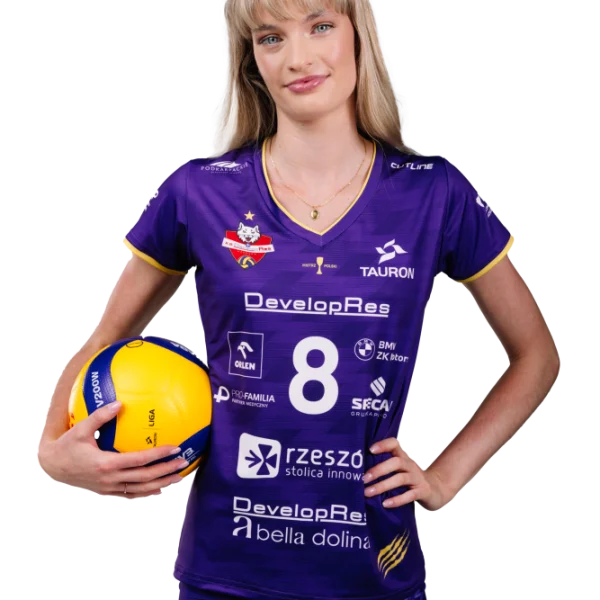
Poland’s women’s national volleyball team carries two very different forms of international stature. Its historical record reaches back to the formative decades of the women’s game, when Poland collected World Championship and Olympic medals with unusual consistency. Its modern relevance has been rebuilt in a different competitive environment: back-to-back European titles in 2003 and 2005 restored the program to continental prominence, while the Stefano Lavarini era has produced three consecutive Volleyball Nations League bronze medals, an Olympic return at Paris 2024 and consecutive World Championship quarterfinal appearances.
The 2026 season made that modern position more complicated rather than less significant. Poland missed the VNL Finals after three straight podium finishes, then reached the EuroVolley semifinals before finishing fourth. Even so, the team closes the international season at No. 5 in the FIVB World Ranking with 360 points, has qualified for the 2027 FIVB Women’s Volleyball World Cup and already knows its next global-stage opponents. Poland was drawn into Pool E in Montréal with Germany, Slovenia and Cuba, making that tournament both the next major championship and a direct route toward Los Angeles 2028.
The current group is also visibly different from the one that returned to the Olympics in 2024. Libero Aleksandra Szczygłowska became captain at the start of the 2026 season, a notable leadership shift for a team in which several younger players are taking larger senior roles. Magdalena Stysiak remains a central attacking reference, but Poland’s 2026 selections also expanded opportunities for Julia Szczurowska, Maja Koput, Julita Piasecka, Paulina Damaske and others who increasingly shape the rotation around her.
Team Information
| Field | Detail |
|---|---|
| Official Team Name | Poland Women’s National Volleyball Team |
| Country | Poland |
| Gender | Women |
| Team Type | National Team |
| National Federation | Polski Związek Piłki Siatkowej (PZPS) |
| FIVB Code | POL |
| Confederation | CEV — European Volleyball Confederation |
| Head Coach | Stefano Lavarini |
| Captain | Aleksandra Szczygłowska |
| FIVB World Ranking | No. 5 — 360 points (snapshot: 27 October 2026) — View full FIVB rankings |
| Current Cycle | 2026–28 / road to Los Angeles 2028 |
| 2027 World Cup Status | Qualified; Pool E in Montréal with Germany, Slovenia and Cuba |
| LA28 Olympic Status | Not yet qualified |
| Olympic Best Result | Bronze — 1964, 1968 |
| World Championship Best Result | Silver — 1952 |
| VNL Best Result | Bronze — 2023, 2024, 2025 |
| European Championship Best Result | Champions — 2003, 2005 |
| Official Federation Website | Polish Volleyball Federation — PZPS |
| Federation Instagram | Polska Siatkówka on Instagram |
| Federation X | Polska Siatkówka on X |
| Federation YouTube | Polska Siatkówka Official on YouTube |
| Federation TikTok | Polska Siatkówka on TikTok |
Poland’s ranking is a current snapshot rather than a permanent team attribute. Volleyball World’s latest published table places Italy first, followed by Brazil, Türkiye and the United States, with Poland fifth on 360 points. PZPS’s current senior-team page continues to list Lavarini as head coach and identifies the active 2026 pool separately from individual tournament squads.
Team History & Development
Poland belongs to the oldest established national programs in international women’s volleyball. The Polish Volleyball Federation’s historical record dates the women’s first official international match to February 1948, against Czechoslovakia. The following two decades established a standard that remains central to Poland’s all-time record: World Championship silver in 1952, bronzes in 1956 and 1962, Olympic bronzes in 1964 and 1968, and repeated European Championship podiums from 1949 through 1971.
That first era was defined by consistency rather than one isolated peak. Poland medalled at each of the first eight European Championships it entered from 1949 through 1971, taking four silver and four bronze medals. At world level, the 1952 silver remains the program’s best World Championship finish, while the Olympic bronzes in Tokyo 1964 and Mexico City 1968 gave Poland two medals in the first two editions of Olympic women’s volleyball.
The program then spent decades outside that level of global contention. Its most important modern reversal came under coach Andrzej Niemczyk. Poland won its first European Championship in 2003 and successfully defended the title in 2005, with a generation built around players such as Małgorzata Glinka-Mogentale, Dorota Świeniewicz and Katarzyna Skowrońska-Dolata. A home EuroVolley bronze followed in 2009. CEV records Poland with 11 European Championship medals in total: two gold, four silver and five bronze.
The next sustained rise took shape in the late 2010s and accelerated after Stefano Lavarini took charge in 2022. Poland reached the 2022 World Championship quarterfinals, its first appearance in that round since 1962. A year later came the first VNL medal in team history, followed by further bronzes in 2024 and 2025. The same cycle returned Poland to the Olympics after a 16-year absence and established the team again as a regular participant in the knockout rounds of major international competitions.
Poland at the Olympic Games
Poland’s best Olympic results belong to its first great era. The women won bronze at Tokyo 1964 and again at Mexico City 1968, putting Poland on the podium at each of the first two Olympic women’s volleyball tournaments. Those medals remain unmatched by a later Polish Olympic team.
After the 1968 Games, Olympic participation became far less regular. Poland returned at Beijing 2008 but did not qualify again until Paris 2024. The 16-year gap made the Paris team a particularly distinct generation: when Lavarini announced his squad, Volleyball World noted that every player was an Olympic rookie. Setter Joanna Wołosz captained the side, while Magdalena Stysiak was already established as one of its principal attacking options. Poland advanced to the quarterfinals before its campaign ended against the United States. The Paris 2024 return was therefore important not because it matched the medals of the 1960s, but because it restored Poland to the Olympic field after nearly two full cycles away.
Los Angeles 2028 is now the next target. Poland did not secure Europe’s direct Olympic berth at EuroVolley 2026, so qualification continues through the 2027 global championship and, if necessary, the FIVB World Ranking pathway in 2028.
World Championship & Other Global Competitions
Poland’s early World Championship record is one of the strongest parts of its historical résumé. The team earned silver in 1952 and bronze in both 1956 and 1962. For decades afterward, however, Poland did not return to the competition’s final eight.
That changed at the 2022 World Championship, co-hosted by Poland and the Netherlands. Lavarini’s team reached the quarterfinals for the first time in 60 years and pushed defending champion Serbia to five sets before being eliminated. That run helped establish the competitive base for what followed in the VNL and the Paris Olympic cycle.
Poland again reached the quarterfinals at the 2025 World Championship. After beating Belgium 3–2 in the round of 16, Poland met eventual champion Italy and lost 3–0. Reaching the last eight in consecutive editions did not produce a medal, but it demonstrated a level of repeatability absent from much of the program’s post-1960s global history.
The next global championship is officially presented by FIVB as the 2027 FIVB Women’s Volleyball World Cup, to be staged in the United States and Canada from 20 August to 5 September 2027. Poland qualified through EuroVolley 2026 and will begin in Montréal.
Poland in the Volleyball Nations League
The VNL has provided the clearest measure of Poland’s modern rise under Lavarini. In 2023, Poland won the preliminary phase and eventually secured bronze, the women’s program’s first medal in the competition. The result was not isolated. Poland returned to the podium with another bronze in 2024 and made it three consecutive bronze medals in 2025.
That streak ended in 2026. Poland entered the final preliminary-round match against Japan with a place in the Finals still available, won the first two sets, then lost 3–2 as Japan completed a reverse sweep. Poland finished the preliminary phase 7–5 with 20 points, just outside the Finals. The match also captured two sides of the 2026 team: Poland controlled the net with 16 blocks, but Japan created a decisive advantage in attacking and serving. Magdalena Stysiak scored 27 points, while Maja Koput and Magdalena Jurczyk recorded five blocks each. The decisive Japan–Poland match ended Poland’s three-year VNL medal sequence.
The setback mattered because VNL had become Poland’s most consistent podium competition. It also exposed a useful distinction in the current cycle: Poland remains capable of matching elite opponents and generating a major blocking advantage, but its margin can disappear when first-contact pressure and transition efficiency move toward the opponent.
European Championship Record
Few teams have participated in EuroVolley as often as Poland. The 2026 tournament was the program’s 33rd European Championship appearance, the first national team to reach that figure. Poland’s 11 medals span two very different periods: the early run from 1949 to 1971 and the modern championship generation of the 2000s.
The defining modern results remain the gold medals of 2003 and 2005. They ended a long wait for a European title and gave Poland consecutive championships, followed by bronze on home soil in 2009. No Polish team has reached the EuroVolley podium since, despite semifinal appearances in 2019 and 2026.
EuroVolley 2026 nevertheless contained several significant results. Poland defeated host Türkiye 3–2 in the pool phase, then beat the Netherlands 3–1 in the quarterfinals. The Netherlands match was particularly revealing from a tactical perspective: Poland produced 17 blocks, with Maja Koput and Magdalena Jurczyk registering five each, and reached its first EuroVolley semifinal since 2019. It was also Poland’s first European Championship victory over the Netherlands since 1983.
Italy stopped Poland 3–1 in the semifinal. Serbia then won the bronze-medal match 3–1, leaving Poland fourth and extending the wait for a first European medal since 2009. Even without a podium finish, reaching the semifinal had another consequence: because Italy had already qualified for the next global championship as the 2025 world champion, Poland’s semifinal berth secured a 2027 World Cup place alongside Serbia and Türkiye.
2026 EuroVolley Squad
PZPS selected the following 14-player roster for the tournament. This is an event-specific squad and should not be confused with Poland’s broader 2026 national-team pool.
| Player | Position |
|---|---|
| Alicja Grabka | Setter |
| Katarzyna Wenerska | Setter |
| Magdalena Stysiak | Opposite |
| Julia Szczurowska | Opposite |
| Martyna Czyrniańska | Outside Hitter |
| Paulina Damaske | Outside Hitter |
| Monika Lampkowska | Outside Hitter |
| Julita Piasecka | Outside Hitter |
| Magdalena Jurczyk | Middle Blocker |
| Maja Koput | Middle Blocker |
| Anna Obiała | Middle Blocker |
| Sonia Stefanik | Middle Blocker |
| Justyna Łysiak | Libero |
| Aleksandra Szczygłowska | Libero / Captain |
2026 Current National Team Pool
PZPS’s current senior-team page lists a 24-player 2026 pool. That list is broader than any one VNL or EuroVolley squad and is the appropriate reference point for the national-team selection as a whole. The federation explicitly describes its season list as open to changes caused by health or other circumstances.
| Player | Position | Club | Height |
|---|---|---|---|
| Oliwia Sieradzka | Opposite | LOTTO Chemik Police | 187 cm |
| Magdalena Stysiak | Opposite | Eczacıbaşı Peron İstanbul | 203 cm |
| Julia Szczurowska | Opposite | Kuzeyboru | 188 cm |
| Magdalena Jurczyk | Middle Blocker | ŁKS Commercecon Łódź | 183 cm |
| Natalia Kecher | Middle Blocker | UNI Opole | 192 cm |
| Maja Koput | Middle Blocker | LOTTO Chemik Police | 190 cm |
| Anna Obiała | Middle Blocker | ŁKS Commercecon Łódź | 187 cm |
| Marta Orzyłowska | Middle Blocker | BKS BOSTIK ZGO Bielsko-Biała | 191 cm |
| Sonia Stefanik | Middle Blocker | ŁKS Commercecon Łódź | 192 cm |
| Julia Bińczycka | Setter | ITA TOOLS STAL Mielec | 173 cm |
| Alicja Grabka | Setter | KS DevelopRes Rzeszów | 180 cm |
| Gabriela Makarowska-Kulej | Setter | UNI Opole | 177 cm |
| Katarzyna Wenerska | Setter | PGE Budowlani Łódź | 177 cm |
| Martyna Czyrniańska | Outside Hitter | Kuzeyboru | 192 cm |
| Paulina Damaske | Outside Hitter | Il Bisonte Firenze | 180 cm |
| Monika Lampkowska | Outside Hitter | Panathinaikos Athens | 183 cm |
| Martyna Łukasik | Outside Hitter | No current club — rehabilitation | 189 cm |
| Natasza Ornoch | Outside Hitter | Bartoccini +energia Perugia | 189 cm |
| Julia Orzoł | Outside Hitter | LOTTO Chemik Police | 182 cm |
| Julita Piasecka | Outside Hitter | KS DevelopRes Rzeszów | 189 cm |
| Klaudia Łyduch | Libero | UNI Opole | 169 cm |
| Justyna Łysiak | Libero | PGE Budowlani Łódź | 172 cm |
| Karolina Pancewicz | Libero | KS DevelopRes Rzeszów | 167 cm |
| Aleksandra Szczygłowska | Libero | KS DevelopRes Rzeszów | 172 cm |
The pool demonstrates how much Poland has broadened its competition for places. Only three opposites are currently listed, but the outside-hitter, middle-blocker, setter and libero groups each contain multiple senior options. Current club information also reflects the 2026–27 season rather than the clubs players represented during the previous national-team year. For example, Kuzeyboru’s current roster includes both Szczurowska and Czyrniańska, while CEV lists Lampkowska with Panathinaikos and the Italian league lists Ornoch with Bartoccini +energia Perugia.
Martyna Łukasik requires separate treatment because her selection status and club status are not the same thing. She remains listed in PZPS’s current national-team pool, but SAGA Hisamitsu Springs announced the mutual termination of her planned 2026–27 contract after an injury suffered during national-team duty was judged to require surgery. The club said rehabilitation would take priority. She is therefore shown above as having no current club rather than being incorrectly assigned to SAGA.
Coaching Staff
Lavarini remains the central figure in Poland’s current project. PZPS’s 2026 staff list also shows a relatively deep support structure around the senior team rather than a narrow head-coach/assistant model.
| Role | Name | Organization |
|---|---|---|
| Head Coach | Stefano Lavarini | Poland / PZPS |
| Assistant Coaches | Nicola Vettori; Krystian Pachliński | Poland / PZPS |
| Collaborating Coaches | Bartosz Sufa; Agnieszka Rabka | Poland / PZPS |
| Statistics Coach | Kacper Duda | Poland / PZPS |
| Statistician | Dominik Fabianowicz | Poland / PZPS |
| Strength & Conditioning Coach | Jakub Gniado | Poland / PZPS |
| Assistant Strength & Conditioning Coach | Maciej Zając | Poland / PZPS |
| Medical Doctors | Marcin Domżalski; Maciej Kijas; Krzysztof Zając | Poland / PZPS |
| Physiotherapists | Dominika Bogaczyk; Edoardo Chimenti; Justyna Pałka | Poland / PZPS |
| Collaborating Physiotherapists | Grzegorz Cieplik; Mikołaj Fabiańczuk | Poland / PZPS |
| Collaborating Assistants | Dawid Biesek; Jakub Koc; Mateusz Maciejewicz; Marcin Wojtulewicz | Poland / PZPS |
| Team Manager | Szymon Szlendak | Poland / PZPS |
| Senior National Teams Director | Hubert Tomaszewski | PZPS |
| Press Officers | Anna Daniluk; Filip Grądek | PZPS |
| Video | Justyna Skubis | Poland / PZPS |
Lavarini’s tenure began in 2022. The most important development under him has been repeatability: a World Championship quarterfinal in his first season, VNL bronze in three successive editions, a return to the Olympics, another World Championship quarterfinal in 2025 and a EuroVolley semifinal in 2026. That sequence is more informative than any single result because it shows Poland functioning as a regular knockout-stage team across different competition formats.
Playing Identity & Team Style
Poland’s current identity is most convincing when described through the present Lavarini cycle rather than as a permanent national style. Personnel have changed substantially, and the 2026 team is still developing combinations that differ from those used at Paris 2024.
The most stable feature is net pressure. Poland can create stretches in which blocking changes both the scoreboard and the opponent’s attacking choices. The EuroVolley quarterfinal against the Netherlands produced 17 Polish blocks, including five each for Koput and Jurczyk. In the decisive VNL match against Japan, Poland recorded 16 blocks to Japan’s two. Those numbers do not make blocking an automatic path to victory—the Japan match was lost—but they show the type of structural advantage Poland can create when its middle blockers read the attack well and the block-defense system closes the court behind them.
The attack still benefits from having a high-volume opposite. Stysiak has filled that role across the recent cycle, giving Poland a 203 cm terminal attacker who can remain involved through imperfect phases of play. The 2026 season also accelerated the emergence of Szczurowska as another genuine scoring option. That matters tactically: it gives Lavarini more room to manage workload, change matchup dynamics and avoid building every match around one opposite.
The outside-hitter competition is wider. Czyrniańska offers size and attacking range; Lampkowska became one of Poland’s most productive VNL attackers in 2026; Damaske and Piasecka were included in the EuroVolley squad; younger options such as Ornoch and Orzoł remain in the broader pool. The central selection question is therefore not simply who scores the most points, but which combinations give Poland the best balance of reception, transition attack and serving pressure against a particular opponent.
Szczygłowska’s captaincy gives the defensive phase additional importance. A libero captain does not alter the six-rotation structure of the sport, but it does make a player responsible for reception and floor defense one of the principal voices in the team. Her appointment is also evidence of the leadership redistribution taking place as Poland moves further from the Wołosz-led Paris cycle.
The 2026 VNL exit also exposed the main limitation of relying too heavily on one strength. Poland could dominate Japan 16–2 in blocks and still lose because Japan won the attacking battle 68–56 and the serving battle 6–2. Against the strongest opponents, Poland’s ceiling depends on turning its size and blocking into complete rallies rather than treating the block itself as the entire defensive solution.
Major Honors
| Competition | Best / Major Results |
|---|---|
| Olympic Games | Bronze: 1964, 1968 |
| FIVB World Championship | Silver: 1952; Bronze: 1956, 1962 |
| Volleyball Nations League | Bronze: 2023, 2024, 2025 |
| CEV European Championship | Gold: 2003, 2005; Silver: 1950, 1951, 1963, 1967; Bronze: 1949, 1955, 1958, 1971, 2009 |
| European Games | Silver: 2015 |
The medal record divides naturally into three periods. The 1949–71 generation established Poland as one of the major teams of early international women’s volleyball. The 2003–09 generation restored European championship success after a long gap. The Lavarini-era teams have not yet added an Olympic, World Championship or EuroVolley medal, but the three consecutive VNL bronzes represent Poland’s most sustained global podium run in decades.
Key Players Across Generations
| Player | Position | Era / Years | Note |
|---|---|---|---|
| Krystyna Czajkowska-Rawska | All-round player | 1950s–1960s | Member of Poland’s double Olympic-bronze generation and the 1962 World Championship bronze team |
| Małgorzata Glinka-Mogentale | Outside Hitter / Opposite | 1990s–2010s | Central figure in the 2003 and 2005 European championship teams |
| Dorota Świeniewicz | Outside Hitter | 1990s–2000s | Two-time European champion and MVP of EuroVolley 2005 |
| Katarzyna Skowrońska-Dolata | Opposite / Middle Blocker | 2000s–2010s | Member of both European title teams and the Beijing 2008 Olympic generation |
| Joanna Wołosz | Setter | 2010s–2024 | Elite playmaker and captain of Poland’s Paris 2024 Olympic return |
| Agnieszka Korneluk | Middle Blocker | 2010s–2020s | Major net presence and leader during Poland’s VNL medal run |
| Martyna Łukasik | Outside Hitter | 2010s–present | Important two-way outside hitter in the VNL-bronze era |
| Magdalena Stysiak | Opposite | 2019–present | Primary high-volume attacker through the recent World Championship, VNL and Olympic cycle |
| Aleksandra Szczygłowska | Libero | 2020s–present | Defensive specialist who became national-team captain in 2026 |
The older and modern generations should not be judged by identical competition structures. The players of the 1950s and 1960s competed in a much smaller international calendar; the 2003–05 group built its identity largely through European Championship success; the present generation faces annual VNL play alongside a denser World Championship and Olympic qualification system. What links them is not a single style, but repeated periods in which Poland moved from being a strong European side to a genuine medal-level international team.
Rivalries & Key Matchups
Poland’s most relevant current matchups are better understood through repeated high-stakes meetings than through permanent rivalry labels.
Italy has become the clearest benchmark. Italy eliminated Poland 3–0 in the 2025 World Championship quarterfinal and again stopped the Poles in the 2026 EuroVolley semifinal. For Poland, closing the gap in those matches means finding ways to preserve its blocking influence without losing too much ground in side-out efficiency and transition quality.
Türkiye occupies a different place in the current European picture. Poland’s 3–2 pool-stage win at EuroVolley 2026 was its first victory over Türkiye at that competition since 2003, but Türkiye went on to win the European title and claim the continent’s direct LA28 quota. The matchup therefore sits at the intersection of a meaningful Polish result and a reminder of the level required to convert a strong tournament into a championship.
Serbia has repeatedly appeared in Poland’s knockout path. Serbia eliminated Poland in a five-set World Championship quarterfinal in 2022 and later beat Poland 3–1 in the 2026 EuroVolley bronze match. Those meetings make Serbia another useful test of whether Poland can turn last-eight and last-four appearances into medals.
Qualification Path & Tournament Cycle
The Los Angeles 2028 qualification system differs significantly from the one used for Paris 2024. There are 12 women’s places. The United States receives the host quota, the five 2026 continental champions receive one place each, three further places go to the highest-finishing teams not already qualified at the 2027 global championship, and the final three are allocated through the FIVB World Ranking after the preliminary phase of VNL 2028. The official FIVB LA28 qualification system therefore leaves more than one route available to Poland.
Poland did not win EuroVolley 2026, so it did not take Europe’s direct Olympic place. Its semifinal appearance did, however, secure qualification for the 2027 FIVB Women’s Volleyball World Cup. FIVB confirmed Poland among the three European continental qualifiers alongside Türkiye and Serbia.
The next step is now concrete. At the global draw on 26 October 2026, Poland was placed in Pool E in Montréal with Germany, Slovenia and Cuba. Pool play runs from 20–25 August 2027 at Bell Centre, with the top two teams from each four-team pool advancing to the round of 16. The three highest-finishing teams at the World Cup that have not already qualified for LA28 will claim Olympic places.
That gives Poland a direct opportunity to qualify in 2027 rather than leaving its Olympic future to the 2028 ranking cutoff. If the team does not secure one of those three World Cup places, its current world-ranking position still leaves the final ranking route highly relevant—but the value must be reassessed after the 2028 VNL preliminary phase rather than projected from the present No. 5 ranking.
Poland in the Current International Cycle
Poland finishes 2026 in a position that is strong but not fully settled. No. 5 in the world is consistent with the team’s recent record of World Championship quarterfinals, VNL medals and a EuroVolley semifinal. At the same time, 2026 stopped the upward rhythm of the previous three seasons: the VNL podium streak ended, and another European semifinal did not become Poland’s first continental medal since 2009.
The more important development may be the widening of the player base. Poland’s 2026 pool contains established international players alongside a group that is still accumulating senior experience. Szczurowska is becoming a meaningful second opposite option; Koput and Jurczyk gave the team substantial blocking production at EuroVolley; the outside-hitter group is deeper than one fixed starting pair; and Szczygłowska has moved from defensive specialist to captain.
There are also unresolved personnel questions. Łukasik’s rehabilitation removes a proven outside hitter from normal club competition for the moment. Other positions remain competitive enough that the eventual 2027 World Cup roster should not simply be assumed from the current 24-player pool or the 14 players selected for EuroVolley.
The central competitive question for 2027 is therefore not whether Poland belongs near the top of the international field—the ranking and recent tournament record already support that. It is whether a transitioning roster can turn repeated quarterfinal and semifinal appearances into a medal at the global level while securing Olympic qualification at the first available opportunity.
Recent Performance Snapshot
| Competition | Result | Context |
|---|---|---|
| 2023 Volleyball Nations League | Bronze | First VNL medal for Poland |
| 2024 Volleyball Nations League | Bronze | Second consecutive podium |
| Paris 2024 Olympic Games | Quarterfinals | First Olympic appearance since Beijing 2008 |
| 2025 Volleyball Nations League | Bronze | Third consecutive VNL bronze |
| 2025 World Championship | Quarterfinals | Beat Belgium 3–2 in R16; lost 0–3 to eventual champion Italy |
| 2026 Volleyball Nations League | Preliminary phase, 7–5 | Missed Finals after 3–2 loss to Japan in decisive match |
| 2026 CEV European Championship | 4th place | Beat Netherlands in QF; lost to Italy in SF and Serbia in bronze match |
| 2027 FIVB Women’s Volleyball World Cup | Qualified | Pool E: Poland, Germany, Slovenia, Cuba; Montréal |
The sequence shows both the improvement and the remaining step. Between 2023 and 2025, Poland converted three straight VNL campaigns into medals and returned to the Olympics. In 2025 and 2026, however, the biggest championship opportunities ended in quarterfinals or semifinals. The 2027 World Cup will test whether the current generation can break that pattern.
FAQ
What is Poland’s current FIVB women’s volleyball ranking?
Poland is No. 5 in the FIVB World Ranking with 360 points in the current snapshot checked on 27 October 2026. Italy, Brazil, Türkiye and the United States occupy the four places above Poland.
Who is the head coach of Poland’s women’s national volleyball team?
Stefano Lavarini is the head coach. He took over in 2022 and remains listed by PZPS as Poland’s coach for the 2026 season. Under his tenure, Poland has reached two World Championship quarterfinals, won three VNL bronze medals and returned to the Olympic Games.
Who is Poland’s women’s national team captain?
Aleksandra Szczygłowska is the current captain. CEV reported that the libero took over the role at the start of the 2026 national-team season.
What are Poland’s best Olympic results in women’s volleyball?
Poland won bronze medals in 1964 and 1968. Those remain the program’s best Olympic finishes. The team returned to the Olympics at Paris 2024 after a 16-year absence.
How many times has Poland won the women’s European Championship?
Poland has won EuroVolley twice, taking consecutive titles in 2003 and 2005. Its overall European Championship medal record is two gold, four silver and five bronze medals.
Has Poland qualified for the Los Angeles 2028 Olympics?
Not yet. Poland did not claim Europe’s direct quota at EuroVolley 2026. It has qualified for the 2027 World Cup, where the three highest-finishing teams not already qualified for LA28 will earn Olympic places. If necessary, three final Olympic berths will be awarded through the FIVB World Ranking after the 2028 VNL preliminary phase.
Who will Poland play at the 2027 Women’s World Cup?
Poland was drawn into Pool E with Germany, Slovenia and Cuba. The pool will be played at Bell Centre in Montréal from 20–25 August 2027.
References
- Volleyball World — Official FIVB Women’s World Ranking
- Polish Volleyball Federation — Poland Senior Women’s National Team 2026
- Polish Volleyball Federation — Broad Poland Women’s National Team Selection for 2026
- CEV — Szczygłowska Ready to Lead Poland into Historic EuroVolley Appearance
- CEV — Stefano Lavarini and Nikola Grbić to Lead Poland’s National Volleyball Teams
- Volleyball World — Japan Complete Reverse Sweep against Poland in Crucial 2026 VNL Match
- CEV — Poland Beat the Netherlands to Reach the EuroVolley 2026 Semifinals
- CEV — Serbia Defeat Poland in the EuroVolley 2026 Bronze-Medal Match
- Polish Volleyball Federation — Poland Squad for CEV EuroVolley Women 2026
- Volleyball World — FIVB Women’s Volleyball World Championship 2025
- Polish Volleyball Federation — Historical Overview of Polish Volleyball
- CEV — Poland’s EuroVolley Medal History
- Volleyball World — Poland Announce Squad for Olympic Return at Paris 2024
- FIVB — Qualified Teams Confirmed for the 2027 Women’s World Cup
- FIVB — 2027 Women’s World Cup Pools Revealed during Global Draw
- FIVB — Volleyball Qualification System for the Los Angeles 2028 Olympic Games
- SAGA Hisamitsu Springs — Martyna Łukasik Contract Termination Announcement
- Kuzeyboru — 2026–27 Women’s Team Roster
- Lega Pallavolo Serie A Femminile — Natasza Ornoch Player Profile
- Eczacıbaşı Spor Kulübü — Magdalena Stysiak Player Profile